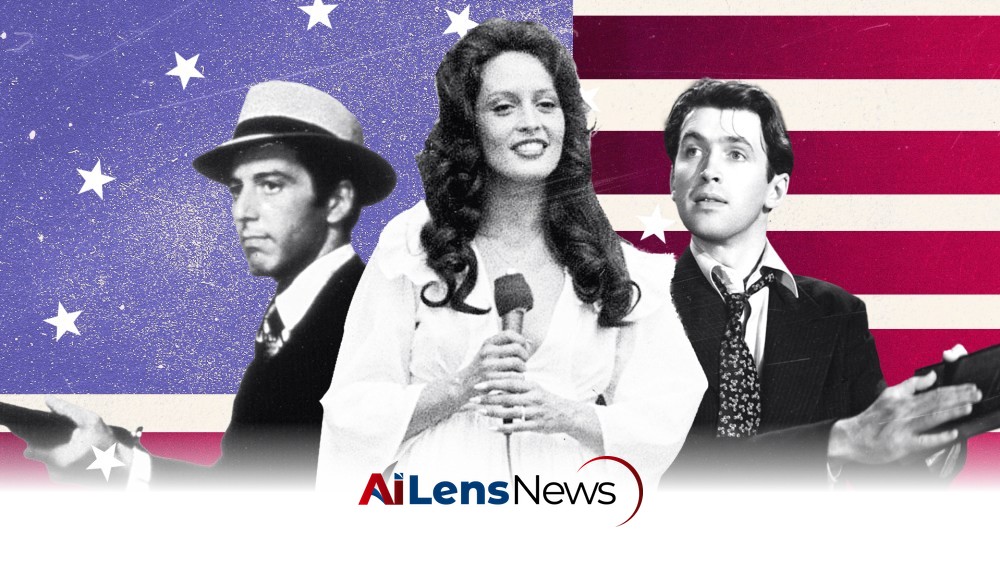


As America celebrates its 250th July 4, the relevance of Hollywood films in reflecting the nation's identity is questioned. A look at iconic movies reveals a shift in storytelling.
New Delhi, India Jul 4, 2026 ALN: A few days ago, the New York Times ran a provocative listicle entitled “What Is the Definitive Movie About America?” Their writers came up with a couple of inspired choices, like “Dazed and Confused,” along with a handful of head-scratchers (“Disclosure Day”? “The Florida Project”?). Since no one asked, I thought I would offer five candidates of my own. They are:
Mr. Smith Goes to Washington (1939). James Stewart, the quintessential American actor, plays a newly appointed senator who shows up in Washington, D.C., overflowing with schoolboy romanticism, only to learn that the place is a rigged game of corruption. In other words, things haven’t changed much. It’s shocking to see how cynically wised-up a Frank Capra movie could be — but, of course, the film is all about how Stewart’s fallen idealist goes to the mat and just about kills himself to save the system. The message: Sustaining the greatness of America is always a war.
The Godfather (1972). In the counterculture era, the wool came off of our eyes about America: how a lot of it really operated, the private values that undergirded our public morality. Francis Ford Coppola’s totemic gangster tragedy was the New Hollywood classic that most deeply channeled the perception of an underworld in control. It used the Mafia as a metaphor for the ruthlessness of capitalism, exposing the dark side of those who are pulling the strings.
Nashville (1975). The greatest movie ever made about what life in America feels like. Robert Altman’s ’70s masterpiece channels the casual tumult of the everyday — the hype and joy and crowdedness and sense of possibility presented by it all. It ends with a song that expresses what may be the single most profound thought about America ever voiced in a motion picture: “You may say that I ain’t free, but it don’t worry me.”
Rocky (1976). Speaking of Capra, Sylvester Stallone’s landmark brought it all back — not just the corn-dog glory of Old Hollywood, but the mythological value system at work in it, the belief that America was a place where an underdog could rise like a god. As much as “Jaws” and “Star Wars,” “Rocky” reset the template for what movies would become, but it also helped to pave the way for Ronald Reagan, and for the persistence of dreams as potent as they might be illusory.
Dirty Harry (1971). In the ’90s, when I started hearing right-wing talk radio in the back of taxi cabs, I saw that the hosts (Michael Savage, Rush Limbaugh) had figured out how to turn every issue into a Charles Bronson movie. The revenge thrillers of the early ’70s, at once vicious and demagogic, became the template for talk radio and Fox News — and for the worldview that grew out of them. And the “Citizen Kane” of those movies was “Dirty Harry,” the rebel-urban-cop thriller that made Clint Eastwood a new kind of nihilist icon. It’s a fantastic piece of cinema with unmistakably disturbing political overtones that have carried over, across half a century, to our own era.
Okay, on this July 4, I wanted to get those great American movies out of my system. But that’s not actually the point of this column. I could have chosen many other films, as I’m sure you could have. What a “definitive” movie about America is will mean different things to different people, because that’s how vast and ever-changing America is.
Yet when I was pondering the question (“What Is the Definitive Movie About America?”), it made me realize how much American movies used to be about America. One of the primal definitions of movies is that every one of them, in its way, is a shared dream. And since the American Dream emerges from our shared, conflicting and collective ideas of what that dream should be, movies have always been the perfect larger-than-life arena in which to hash that out.
But the age of movies about America may now be fading. Today, the definition of the country is in flux, more so than it’s been in a long time. Are we still a democracy? More to the point: Do we still believe in democracy as a fundamental value — as the fundamental value? I’d argue that increasingly large numbers of people do not. And as “Mr. Smith Goes to Washington” demonstrated, you’re not going to have a democracy unless you’re willing to fight for it. If you aren’t, what you might get instead is a “Godfather” nation.
When did American movies stop being about America? In the studio-system era, the movies played a major role in defining what America was. You could say that the original Hollywood moguls created a white-picket-fence America that was more mythology than reality, yet there’s no denying that people strived to achieve it; what you see in so many movies from classic Hollywood is an image of values and behavior that’s very much aspirational. From the clash between freedom and the law that defines the Western genre to the impassioned assertion of fairness in a film like “12 Angry Men” to such profound dramatic examinations of the fight for racial justice as “In the Heat of the Night,” movies showed us what we wanted America to be.
And in the New Hollywood era, by dramatizing how far America had fallen from many of those ideals, movies showed us bold new truths — but they also put us back in touch with the spirit of idealism in a different way. The new films, from “Midnight Cowboy” to “Chinatown” to “McCabe & Mrs. Miller” to “Dog Day Afternoon” to “Shampoo,” were often shot through with cynicism and despair, and they had wrenchingly flawed heroes and heroines. Yet these movies, too, tapped into American dreams. It was now the disconnect between what the characters were living and what they were dreaming that defined the very space of American cinema.
Today, more and more, the space of American cinema is defined by one word: fantasy. And without veering into a harangue against fantasy culture, it’s worth noting that the fantasy worlds where our movies increasingly take place add up, in both philosophy and sensation, to a kind of abstract no-man’s land. The films are set in distant galaxies, or in the hermetic jump-scare funhouse of the horror imagination, or in candy-colored animated landscapes designed to be friendly to five-year-olds.
Occasionally, you do see a deep-dish movie about America, and when that happens it can strike a rich chord. I think audiences experienced that last year with “One Battle After Another,” which had the daring to be topical in the extreme — to take a spiritual inventory of what was going on in the country right now, the discord and the oppression and the desperate gulping for the oxygen of freedom. And three years ago, “Oppenheimer” was a historical drama that felt like a catharsis, a referendum on what the American invention of the nuclear bomb not only involved but what it meant, and what its fallout was.
Yet it’s hard not to think of these as grand exceptions. When it comes to movies, the disconnect I’m feeling on our 250th celebration of July 4 is the one between the extraordinary upheaval America is going through right now, when it seems as if everything that was taken for granted for so long — the stubborn persistence of the middle class, the values of free speech and democracy — is up for grabs, and the fact that we’re doomscrolling through all of this, living it each day online, in our conversations, in our families, but not seeing it reflected in the metaphysical mirror the movies have always been. I don’t know if it would even be possible for a Hollywood film to offer a “definitive” vision of our tumultuous times. More than ever, though, what we need today is for movies to start looking at America again, so that they can once again give us the big picture.
To learn more about the latest developments in Movies, stay updated with our exclusive reports and analyses on AiLensNews.

