

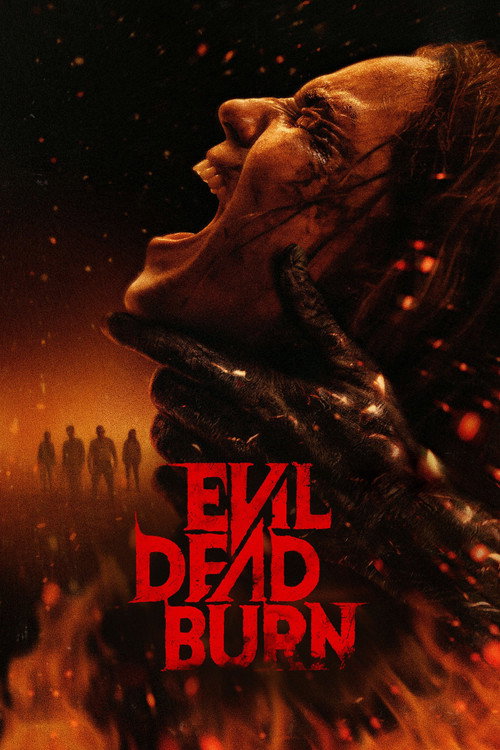






Evil Dead Burn emerges from the shadows of its illustrious franchise with a promise of visceral horror and inventive effects, but in the end, it reveals itself as a heavy-handed installment that leans too far into brutality at the expense of narrative nuance. Following Alice, whose family turmoil kicks off just after her husband’s tragic death, the film takes a predictable turn into unrelenting terror as her husband’s family transforms into fear-infused monstrosities. It could have explored rich themes of grief and familial legacy, yet it largely chooses to wallow in gore instead.
The craftsmanship is undeniably impressive; the practical effects in particular are a highlight. The design of the demonic transformations is both grotesque and creative, showcasing a level of detail that enhances the creepiness. One standout sequence sees a character's transformation into a fear-wielding creature, a moment that strikes a chilling balance between creativity and horror. Here, the filmmakers effectively use practical effects to create a visceral experience that will appeal to horror aficionados seeking innovative imagery. However, this high level of technical ability does little to save the film from its own shortcomings.
Therein lies the film’s primary conflict: despite its graphical impressiveness, the storytelling feels stilted and lacks the wit that has traditionally characterized the Evil Dead series. Earlier installments managed to juxtapose moments of terror with elements of dark humor, forming a compelling balance that kept audiences engaged. Burn, however, often forgets humor exists and instead forces the audience through an endless cycle of violence that begins to feel monotonous by the film’s mid-point. Dialogues come off as expository at times, mainly serving to advance the plot rather than deepen character motivation or establish stakes. While Alice’s struggle is supposed to resonate with viewers grappling with loss, the reliance on bloodshed over emotional depth detracts from her journey.
Additionally, the screenplay has some glaring issues. The pacing feels uneven, as scenes either drag on, driven by gratuitous gore, or rush headlong into climactic moments without proper buildup or character investment. This inconsistency results in a viewing experience that is jarring, pulling you out of the horror when you’re supposed to be on the edge of your seat. The film frequently forgets to establish meaningful connections despite attempting to craft an intimate story of grief and enduring love.
That being said, there are flashes of potential lurking underneath the surface. The film’s cinematography is notable as it captures the eerie atmosphere of descent into horror effectively, a feat made all the more impressive by its aesthetic choices, such as lighting and framing. However, these artistic endeavors do not compensate for the story's deficiencies or the lack of engaging character arcs. Alice's journey feels like a familiar template, never fully diverging into unexpected territory, while the supporting cast feels underdeveloped, their arcs limited to mere plot devices rather than multi-dimensional characters.
In the context of a franchise that has prided itself on its ability to weave humor, horror, and genuine emotional stakes, Evil Dead Burn comes off as a disjointed entry. While the intention to craft a fresh narrative is apparent, the execution stumbles as it clashes with the legacy of its predecessors. There are thrills and effective scares peppered throughout, ensuring that hardcore horror fans may find some enjoyment in the brutal visuals alone. However, the lack of balance leaves it feeling more like an endless barrage of violence rather than a well-rounded horror experience.
In the end, Evil Dead Burn may satisfy those eager for gore but fails to leave a lasting impression beyond its fleeting moments of horror. It serves as a reminder that while spectacle can be engaging, it must not overshadow substance if a film hopes to resonate on any meaningful level.