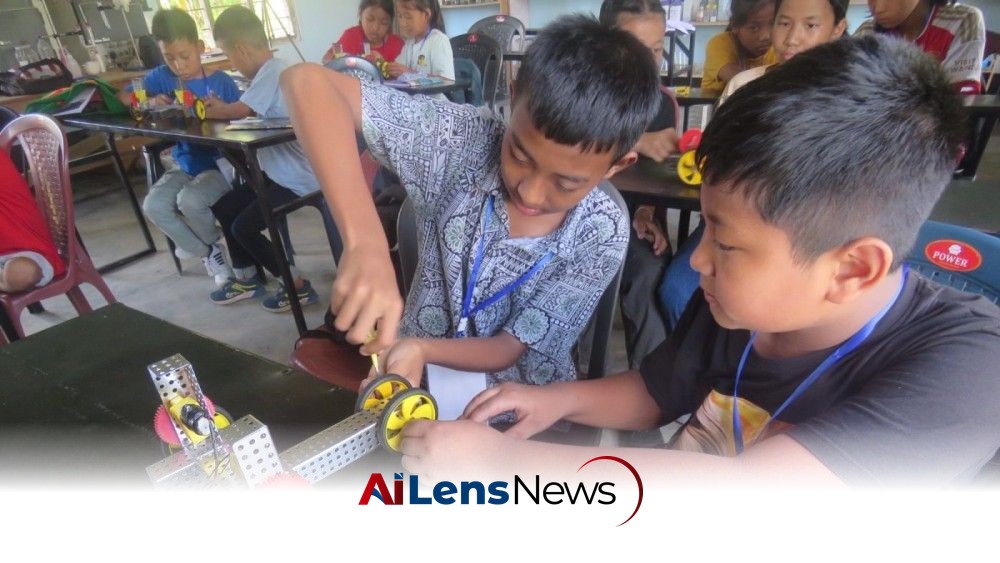


Zenwang Konyak's Summer Science Camp in Mon district fosters scientific curiosity among children, bridging educational gaps through hands-on learning.
Kohima, India Jul 13, 2026 ALN: In a region with scarce resources and limited opportunities for hands-on science learning, Zenwang Konyak, a young researcher from Nangtan village in Mon district, is quietly fostering scientific curiosity. Through a modest summer camp, he provides children with the opportunities he once lacked.
As the founder of Zen Scientific, Konyak organizes the camp with a simple conviction: science should not remain confined to textbooks. "I wanted to teach students how fun science can be with full of activities," he said.
Launched in 2024, the Summer Science Camp was the first of its kind in Mon district, introducing students to microscopy, telescopy, robotics, engineering workshops, and various science experiments.
The program attracted 38 students from nine schools, aiming to promote STEM education and encourage students to pursue science-related fields in the future.
However, the journey almost ended before it began. A week before the inaugural camp, only five students had registered. "It was really disappointing. But I thought that if I could make even these few students interested in science, it would still be worth organizing," Zenwang recalled.
Refusing to cancel the program, he sought help from friends and family members who personally reached out to parents and students. The response eventually grew, and the camp became a memorable experience for dozens of children.
The impact was immediate. Many students were amazed to discover that science could be fun and practical. Activities such as building water rockets and Arduino-based robotic cars became favorites among the participants.
The camp also aimed to bridge a larger educational gap. "Many schools do not have proper science laboratories because they are expensive. So, many students may not have good exposure to hands-on science," he explained.
For Zenwang, the initiative is deeply personal. A former student of Holy Angels School, Tizit Town, and Government Higher Secondary School, Mon, he pursued a Bachelor of Science degree from Kohima Science College (KSC), Jotsoma, followed by a master’s degree from the University of Lumami. He is currently pursuing a PhD program at KSC.
He admitted that, like many students from the region, he had little exposure to practical science growing up. "Being honest, we did not receive much science exposure. But everything about science fascinates me. I guess I’m doing what I loved the most," Zenwang said.
One of the things he enjoys most is being around bright and curious young minds. "I like being with young brilliant minds, and it makes me happy when such brilliant minds come together. The only possible way to bring them together is through such events and activities," he said.
Since childhood, he enjoyed making things, dismantling objects, and trying to repair them. "Sometimes I would break things and sometimes repair them. Actually, I wanted to be an engineer, but fate had other plans, I guess," he said.
Many of his close friends and well-wishers contributed to organizing the event. He specifically thanked the Sustainable Development Goals Coordination Centre (under the Planning and Transformation Department) for supporting the laboratory setup through the SDG Innovation Participatory Action Research (IPAR) Initiative 2.0.
Zenwang also acknowledged Health and Family Welfare Minister P Paiwang Konyak for financial support toward the first camp in 2024. He thanked Borosil for donating a MiniLab under its “Love for Science” initiative, which made hands-on experiments more accessible for students. The Departments of Botany and Zoology at KSC donated unused specimens and equipment, and he noted the support of NagaBots Pvt Ltd during the first edition, which provided free training.
He gave special credit to the Nangtan Students’ Union (NSU) for consistent backing. "The best support I received was from NSU… It was a collective effort from them as well."
This year’s camp is again organized under the SDG IPAR Initiative 2.0, but support is limited to materials and equipment. Despite approaching several departments, no additional funding was secured. As a result, the camp is being run largely through registration fees, personal contributions, and donations, with organizers still seeking sponsors. Some well-wishers have sponsored deserving students to ensure financial constraints do not hinder participation.
The second edition of the camp, scheduled in Nangtan village, Tizit on July 14–15, has expanded to include robotics challenges, science experiments, telescope observation, and stargazing sessions. New chemistry and biology experiments, along with additional robotics activities, have also been introduced.
Beyond the camp, Zen Scientific has launched a “Sponsor a Young Scientist” campaign to support students who cannot afford registration fees. Contributions help cover laboratory charges, chemicals, training materials, and accommodation, ensuring financial constraints do not hinder participation.
Zenwang hopes government departments and institutions will view such efforts as investments in young minds, not wasted resources. "Even a small amount of support helps acquire valuable equipment that is important for teaching," he said.
Despite growing interest, challenges persist. "I needed a building entirely for the lab, which I’m not able to get funding for and don’t know whom to approach as well. So, I’m using a temporary space available. The rest, I think, will grow eventually," he said.
Still, his vision reaches beyond Tizit. He hopes to attract young science enthusiasts from across eastern India and believes similar camps could succeed in other districts with adequate support and committed organizers.
"Invest in activities that benefit the state. We need more people who truly love science," he said.
For him, the greatest reward is giving children opportunities he never had. "It makes me so happy that I could organize and help students experience something I did not receive," he said.
He believes nurturing scientific curiosity could transform the state. "It will be a boon for the future. Personally, it will be my success," he added.
To learn more about the latest developments in Education News, stay updated with our exclusive reports and analyses on AiLensNews.

