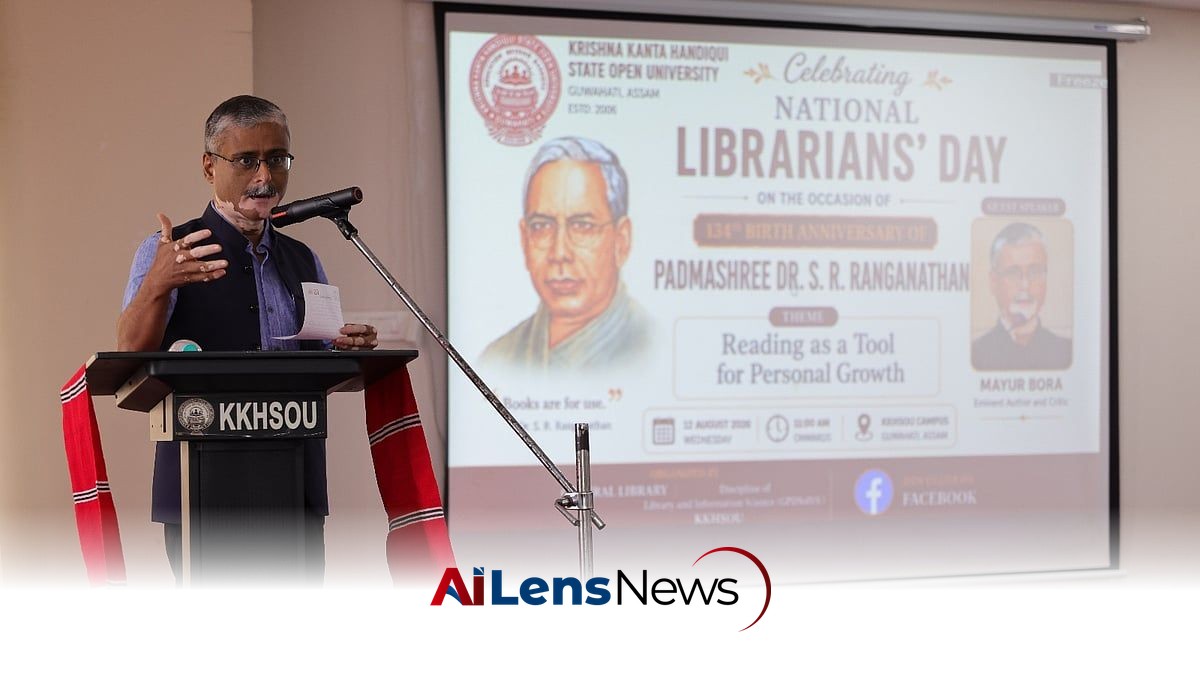


The Krishna Kanta Handiqui State Open University celebrated National Librarians' Day, focusing on reading as a vital tool for personal growth.
Imphal, India Aug 13, 2026 ALN: Guwahati: On 12th August, the Krishna Kanta Handiqui State Open University (KKHSOU) celebrated the 134th National Librarians’ Day with a programme organised by the Central Library in collaboration with the Discipline of Library and Information Science, (GPDSoIVS). This annual event is significant in the Indian context as it commemorates the birth anniversary of Padma Shri Dr. S. R. Ranganathan, who is revered as the father of library science in India. Dr. Ranganathan's contributions to the field have established foundational principles that continue to guide library practices and philosophies today. The theme for this year's celebration was “Reading as a Tool for Personal Growth,” a topic that resonates deeply in an age where information is increasingly consumed through digital means.
National Librarians' Day was first observed in India in 1972, marking the birth anniversary of Dr. Ranganathan, who was a pioneering figure in library science. His five laws of library science, which emphasize the importance of books, the reader, and the library as a service organization, remain relevant today. These principles advocate for the idea that libraries should be accessible to all and that the focus should always be on the needs of the user. As technology has evolved, the role of libraries has also transformed, but the core values espoused by Dr. Ranganathan continue to influence library practices across the country.
Renowned Assamese writer, literary critic, and motivational speaker Shri Mayur Bora delivered a lecture on “Reading as a Tool for Personal Growth.” In his address, he underscored the importance of reading in cultivating critical thinking skills and fostering creativity. While acknowledging the rapid advancements in artificial intelligence that provide instant access to vast amounts of information, Bora argued that the act of reading itself nurtures emotional maturity and a profound understanding of societal and cultural dynamics. He emphasized that reading printed books, in particular, allows for a more immersive and reflective experience, which is often lost in the quick consumption of digital content. His reflections on Assam’s rich literary heritage served as a reminder of the region's contributions to literature and the arts, encouraging young readers to explore this legacy and develop a lifelong reading habit.
In recent years, the shift towards digital media has raised concerns about the decline of traditional reading practices. Studies have shown that while digital content is often more accessible, it can lead to superficial reading habits that do not engage the reader in the same way as printed texts. Bora's emphasis on the tactile experience of reading printed books highlights the importance of fostering a reading culture that values depth and comprehension over mere access to information. This perspective is particularly relevant in educational settings where the goal is not just to consume information, but to engage with it critically.
Dr. Gobinda Deka, the Director (i/c) of GPDSoIVS, also spoke at the event, highlighting the vital role of libraries in supporting open and distance learning. Libraries are not merely repositories of books; they are dynamic spaces that facilitate learning and personal development. Dr. Deka pointed out that in the context of distance education, libraries serve as crucial resources that provide access to essential information and materials that empower learners. Furthermore, he noted that libraries are instrumental in promoting lifelong education, a concept that is increasingly important in today's fast-paced world where continuous learning is necessary to adapt to changing job markets and societal needs.
The role of libraries in open and distance learning is particularly crucial as they provide resources that may not be readily available to all students. In many cases, distance learners face challenges in accessing physical books and materials, making the library a vital support system. By offering digital access to resources, libraries can bridge the gap for these learners, ensuring they have the tools necessary for academic success.
Prof. N. N. Sharma, Director of MDSoM, BKCIKS, also contributed to the discussions by encouraging students and researchers to experience the unique value of reading printed books. He posited that while digital formats are convenient, the tactile experience of holding a book and the cognitive processes involved in reading printed text lead to deeper learning and reflection. This sentiment is supported by various studies that suggest reading physical books can enhance comprehension and retention of information compared to digital reading. The sensory experience of turning pages, annotating texts, and the reduced distractions of a physical book can create a more conducive environment for learning.
The event was attended by over 100 participants, including students, faculty members, and library professionals, and was live-streamed on Facebook, attracting more than 6000 online viewers. This broad reach underscores the growing interest in library science and the importance of reading in contemporary society. The decision to live-stream the event also reflects a trend towards greater accessibility in educational programming, allowing individuals who could not attend in person to engage with the content and discussions. Such initiatives are crucial in promoting inclusivity in education, ensuring that diverse audiences can participate in valuable discussions about literacy and learning.
The programme concluded with a vote of thanks by Shri Dibyajyoti Patgiri, Assistant Librarian of the Central Library at KKHSOU. In his closing remarks, he reaffirmed the University’s commitment to promoting a reading culture and lifelong learning among its students and the wider community. This commitment is particularly relevant as educational institutions increasingly recognize the need to foster environments that encourage inquiry and exploration beyond the classroom. By cultivating a culture of reading, institutions can empower students to become lifelong learners, equipped with the critical thinking skills necessary to navigate an information-rich world.
National Librarians' Day serves not just as a celebration of the profession but also as a call to action for individuals and institutions to prioritize reading and literacy. In an era characterized by rapid technological advancement and information overload, the ability to read critically and engage with texts meaningfully is more important than ever. Libraries play a pivotal role in this landscape, serving as gateways to knowledge and tools for personal and professional development. They are not just places to borrow books; they are community hubs that foster collaboration, creativity, and lifelong learning.
As the event at KKHSOU illustrated, the celebration of National Librarians' Day is an opportunity to reflect on the transformative power of reading and the essential role libraries play in our lives. It is a reminder that, despite the conveniences offered by modern technology, the fundamental human experience of reading remains irreplaceable. The discussions and insights shared during the event are likely to inspire attendees to not only enhance their own reading habits but also advocate for the importance of libraries in their communities. The support for libraries and reading initiatives can lead to more informed and engaged citizens, ultimately benefiting society as a whole.
In conclusion, the observance of National Librarians' Day at KKHSOU is part of a larger movement within educational institutions to foster a culture of reading and lifelong learning. By highlighting the contributions of figures like Dr. S. R. Ranganathan and emphasizing the importance of reading in personal growth, events like this serve to inspire future generations to engage with literature and the world of knowledge more deeply. The ongoing dialogue about the significance of libraries and reading is essential as we navigate an increasingly complex information landscape, ensuring that the values of literacy and learning remain at the forefront of educational priorities.
- KKHSOU organises awareness programme on Energy Conservation and Renewable Energy
To learn more about the latest developments in Education News, stay updated with our exclusive reports and analyses on AiLensNews.

