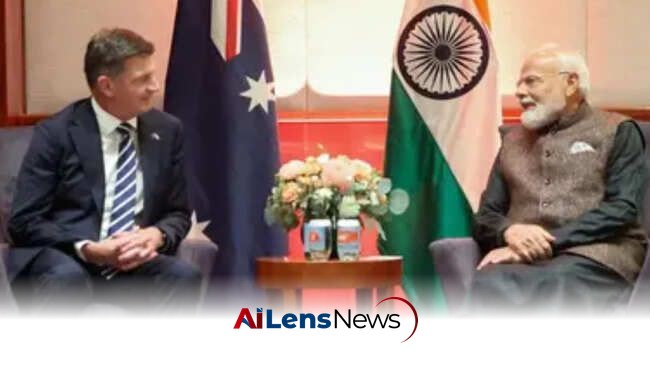


During his visit to Australia, Prime Minister Narendra Modi met Opposition Leader Angus Taylor to discuss strengthening bilateral relations and defense ties.
New Delhi, India Jul 10, 2026 ALN: Melbourne: Prime Minister Narendra Modi, currently on a three-day visit to Australia, met the country's Leader of Opposition, Angus Taylor, on Friday to discuss bilateral ties, according to the Ministry of External Affairs. This meeting underscores the importance of bipartisan support in Australia for strengthening relations with India, a sentiment echoed by both leaders during their discussions.
The India-Australia relationship has been evolving significantly over the past few years, particularly in the context of the changing geopolitical landscape in the Indo-Pacific region. The Comprehensive Strategic Partnership, established in 2020, has served as a framework for collaboration across various sectors, including defense, trade, and technology. Modi's meeting with Taylor reflects the growing recognition among Australian political leaders of the strategic importance of India as a partner in addressing regional challenges.
"They held productive discussions on the growing India-Australia Comprehensive Strategic Partnership. The warm and cordial meeting reflected the strong bipartisan support in Australia for deepening ties with India," stated Ministry of External Affairs Spokesperson Randhir Jaiswal. This statement highlights the collaborative spirit that both nations are fostering, which is crucial for addressing shared concerns such as security, climate change, and growth.
In a post on the microblogging platform, Prime Minister Modi shared insights from his interaction with Taylor, stating, "Met Mr. Angus Taylor, Leader of the Opposition of Australia. We had an engaging conversation on the growing strength of India-Australia ties and the many opportunities ahead. I deeply value the warmth and broad support that our partnership enjoys across Australia." This expression of mutual respect and acknowledgment of the potential for future collaboration is indicative of the positive trajectory of the bilateral relationship.
Modi's visit to Australia comes after his trip to Indonesia and precedes his departure for New Zealand, marking the final leg of a six-day, three-nation tour. Such diplomatic engagements are essential for leaders to foster relationships that can lead to concrete agreements and collaborations. During his time in Australia, Modi participated in significant discussions and meetings that culminated in the signing of several landmark pacts related to civil nuclear energy, maritime security, and critical minerals sectors.
One of the focal points of Modi's discussions with Australian Prime Minister Anthony Albanese was the emphasis on enhancing defense ties, particularly in the maritime domain. Given the strategic importance of the Indo-Pacific region, both leaders recognized the need for stronger cooperation to ensure peace and stability. This aligns with broader global trends where countries are increasingly focusing on collective security arrangements in response to rising tensions and challenges.
A major highlight of the summit was the agreement on civil nuclear energy, which was sealed to facilitate the commercial supply of uranium from Australia to India. This agreement is particularly significant as India seeks to expand its nuclear power capabilities to meet its growing energy demands while transitioning to cleaner energy sources. After over two years of negotiations, this agreement marks a critical step in bolstering energy security and sustainability for both nations.
In addition to the civil nuclear agreement, India and Australia have committed to working expeditiously to finalize the proposed Comprehensive Cooperation Agreement (CECA) and a bilateral investment protection framework. These initiatives are aimed at enhancing trade and investment relations, which have seen substantial growth in recent years. The CECA, in particular, is expected to create new opportunities for businesses and investors in both countries, thereby fostering growth and job creation.
Among the 18 pacts signed following the summit talks were a joint declaration on defense and security cooperation, a maritime security collaboration roadmap, and a partnership for cyber, critical technologies, and supply chains. These agreements reflect a comprehensive approach to collaboration that spans various sectors, highlighting the multifaceted nature of the India-Australia partnership.
PM Modi also advocated for the early finalization of the proposed India-Australia Comprehensive Cooperation Agreement (CECA), emphasizing its potential to further accelerate bilateral trade and investment ties. This proactive approach demonstrates India's commitment to deepening relations with Australia, which is seen as a key partner in the Asia-Pacific region.
Furthermore, the prime minister addressed an Indian diaspora event, 'Melbourne meets Modi,' which was also attended by Australian Prime Minister Anthony Albanese. This event provided an opportunity for Modi to connect with the Indian community in Australia, which plays a vital role in strengthening people-to-people ties between the two nations. The Indian diaspora has been instrumental in promoting cultural exchange, collaboration, and fostering mutual understanding.
The implications of Modi's visit and the discussions held during this trip are significant for both countries. As India continues to rise as a global power, its relationship with Australia is likely to become increasingly important in the context of regional security and dynamics. The commitment to enhancing defense ties, coupled with agreements in critical sectors such as energy and technology, positions both nations to address shared challenges and capitalize on emerging opportunities.
In conclusion, PM Modi's meeting with Australia's Leader of Opposition, Angus Taylor, along with his discussions with Prime Minister Anthony Albanese, marks a pivotal moment in the India-Australia relationship. The agreements and collaborative frameworks established during this visit are expected to pave the way for deeper engagement and cooperation, ultimately contributing to a more stable and prosperous Indo-Pacific region. As both countries navigate the complexities of global politics, their partnership will likely play a crucial role in shaping the future of the region and beyond.
To learn more about the latest developments in Trade & Commerce, stay updated with our exclusive reports and analyses on AiLensNews.

