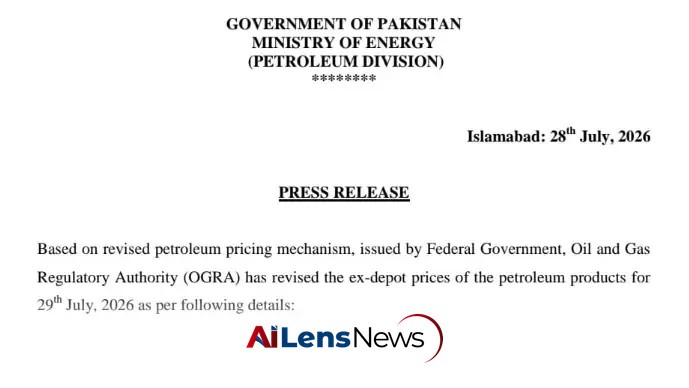


The government has increased petrol prices by Rs1.63 and diesel prices by Rs1.55 per litre, reflecting global oil price changes due to renewed tensions in the Persian Gulf.
Islamabad, Pakistan Jul 29, 2026 ALN: The recent decision by the government to increase petrol and high-speed diesel (HSD) prices has drawn attention amid ongoing fluctuations in global oil markets. On Tuesday, the government announced an increase of Rs1.63 per litre for petrol and Rs1.55 per litre for diesel. This adjustment has been attributed to the rising costs stemming from renewed hostilities in the Persian Gulf, which have historically influenced oil prices due to geopolitical tensions in the region. The fluctuations in oil prices are not merely a local issue; they resonate globally, affecting economies and consumers worldwide.
As a result of this price hike, petrol will now retail at Rs335.81 per litre, while HSD will cost Rs388.38 per litre. The government’s continued imposition of taxes and duties on these fuels remains significant, with Rs110 per litre on petrol and Rs96 per litre on diesel. These taxes are a crucial part of the government's revenue stream, reflecting the importance of petroleum products in the national economy. The reliance on fuel taxes underscores a broader fiscal strategy, wherein the government seeks to balance its budget while managing public expectations regarding fuel prices.
The Petroleum Division's notification indicated that the new prices would take effect on July 29 (Wednesday), marking another adjustment in a long series of price changes that have occurred in recent months. The price of diesel, for instance, has decreased from a staggering peak of Rs520.35 recorded on April 3, following a substantial increase that began when the US-Iran conflict escalated on February 28. This conflict has had a direct impact on oil supply chains, leading to increased prices globally. The interplay of geopolitical factors and market dynamics illustrates how external events can ripple through domestic economies, affecting everything from transportation costs to consumer goods pricing.
Similarly, petrol prices have seen a dramatic rise, peaking at Rs458.41 on April 3 after starting at Rs266 in early March. Such fluctuations can be attributed to a combination of factors, including global market trends, currency exchange rates, and local economic conditions. The government's decision to adjust prices regularly is a response to these volatile conditions, reflecting the need to align domestic pricing with international market realities. This alignment is crucial for maintaining economic stability, as sudden price shocks can lead to inflationary pressures across the economy.
In light of the ongoing instability in the Middle East, Petroleum Minister Ali Pervaiz Malik announced that fuel prices would now be fixed on a daily basis. This shift aims to provide a more responsive pricing mechanism that can quickly adapt to changes in international oil prices. The decision comes as a part of broader measures introduced by the government to cope with potential oil supply disruptions and to manage the economic implications of fluctuating fuel costs. By adopting a daily pricing model, the government hopes to mitigate the effects of sudden price spikes and to provide consumers with more predictable fuel costs, although this has raised concerns among various stakeholders.
Since early March, the government has been revising fuel prices weekly, alongside implementing measures aimed at conserving fuel. These measures are particularly crucial given the potential for further disruptions in oil supply due to geopolitical tensions. In April, the federal government also introduced targeted relief measures to provide subsidized fuel, aiming to cushion the impact of rising prices on consumers. These subsidies are intended to alleviate some of the financial burden on lower-income households, which are disproportionately affected by rising fuel costs.
The new pricing approach has not been without controversy. The All Pakistan Dealers Association has expressed its discontent with the decision to implement daily pricing, stating that it would consider a protest plan in response. This indicates a growing concern among fuel dealers about the impact of such frequent changes on their businesses, as well as on consumers who may struggle to keep up with rapid price fluctuations. The protests could also signal a broader dissatisfaction with government policies regarding fuel pricing and taxation, highlighting the need for a more inclusive dialogue with stakeholders.
The implications of these price changes extend beyond immediate financial considerations. Petrol is predominantly used in private transport, small vehicles, rickshaws, and two-wheelers, meaning that changes in petrol prices directly affect the middle and lower-middle classes, who rely heavily on these modes of transportation for their daily commutes. Similarly, diesel is crucial for the heavy transport sector, powering trucks, buses, and large generators, and is also used in power plants. Therefore, fluctuations in diesel prices have a widespread impact on the public, influencing the cost of goods and services across various sectors. This ripple effect underscores the interconnectedness of fuel prices with overall economic health and consumer behavior.
Petrol and high-speed diesel are significant revenue earners for the government, with monthly sales figures ranging between 700,000 to 800,000 tonnes. In comparison, kerosene, another petroleum product, sees only about 10,000 tonnes of monthly demand, highlighting the dominant role that petrol and diesel play in the national energy landscape. The revenue generated from these fuels is vital for funding government operations and public services, making the management of fuel prices a critical aspect of fiscal policy. As such, the government must carefully navigate the balance between generating revenue and ensuring that fuel remains affordable for consumers.
As the government navigates the complexities of global oil markets and domestic economic pressures, the decision to adjust fuel prices will likely continue to evoke strong reactions from various stakeholders, including consumers, businesses, and political entities. The balance between maintaining economic stability, ensuring adequate revenue generation, and addressing the needs of the public will remain a challenging task for policymakers in the face of ongoing global uncertainties. The need for a comprehensive energy policy that addresses both supply security and price stability is becoming increasingly clear, as the government seeks to respond to the challenges posed by a volatile global oil landscape.
In conclusion, the recent price hike of petrol and diesel is emblematic of the broader challenges facing economies reliant on fossil fuels amidst geopolitical instability. As the government implements daily price adjustments, stakeholders must remain vigilant and engaged in discussions about the future of energy policy, ensuring that the needs of all citizens are considered in the pursuit of economic stability and growth. The dialogue surrounding fuel pricing will undoubtedly continue to evolve, reflecting the dynamic nature of both domestic and international factors influencing the energy sector.
To learn more about the latest developments in Inflation & Prices, stay updated with our exclusive reports and analyses on AiLensNews.

