

More
Checking your session
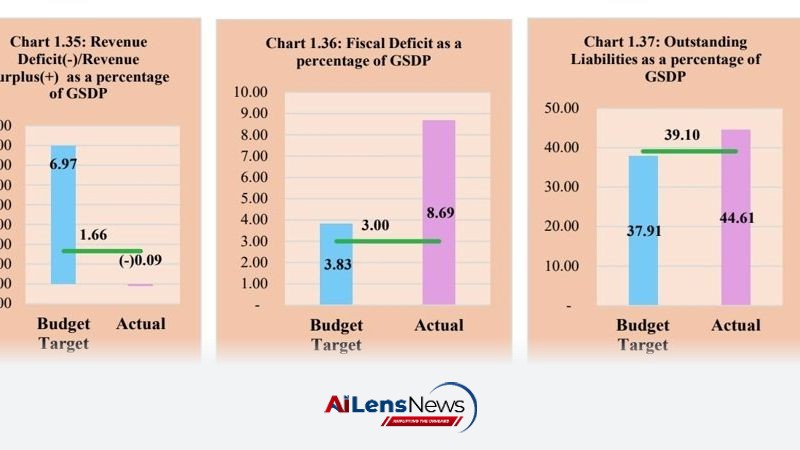



The CAG's report highlights escalating debt concerns in , with liabilities nearly doubling since 2020, raising questions about fiscal sustainability.
Shillong, India Aug 29, 2026 ALN: The Comptroller and Auditor General of India (CAG) has flagged concerns regarding the state of 's debt profile in the report for the year 2024-25, which was tabled in the Assembly today. This report has raised alarms about the sustainability of the state's finances, particularly in light of the significant increase in debt levels over recent years.
Debt is a contentious issue in politics, with the opposition frequently arguing that the state’s liabilities are getting out of control. This concern is not unfounded, as rising debt can lead to increased financial vulnerability, reduced fiscal flexibility, and potential insolvency risks. However, the government has countered that it is borrowing for 's growth and that much of the loans are interest-free, which they argue makes the debt more manageable in the short term.
From the Covid-19 pandemic year of 2020-21, 's overall debt has nearly doubled from Rs 13,618.73 crore to Rs 26,601.45 crore in 2024-25. This includes a substantial 50-year interest-free loan from the central government under Special Assistance to States for Capital Investments amounting to Rs 5,192.91 crore. While interest-free loans can provide some relief, the sheer volume of borrowing raises questions about long-term sustainability and the state’s ability to manage its finances effectively.
Over the five-year period, the growth rate in overall debt exceeded the growth rate in Gross State Domestic Product (GSDP) at current prices, except in 2021-22, which witnessed faster GSDP growth post-Covid. “This trend of persistent excess suggests rising debt stress,” the CAG stated, indicating that the state may be heading towards a fiscal crisis if corrective measures are not taken. The growth of debt compared to economic output is a critical factor in assessing financial health, and the CAG's observations highlight a troubling trend.
Over the 10 years from 2015-16 to 2024-25, overall debt growth outpaced the nominal GSDP growth rate except in 2015-16, 2017-18, and 2021-22. This consistent pattern of rising debt relative to economic growth is alarming, as it signifies that the state is not generating enough economic activity to support its borrowing levels. In terms of the debt to GSDP ratio, 's figure rose to a high of 44.61 percent in 2024-25. This ratio measures the state’s capability to repay its debt. A low value of debt to GSDP indicates that the state’s economy is vibrant enough to pay the debt without incurring further debt. Conversely, a high ratio signifies that the state’s burden is substantial compared to its economic output, indicating financial vulnerability and reduced fiscal flexibility.
Although Covid caused this ratio to worsen, there was also a boom in the economy in the following year. From 2022-23, however, the debt to GSDP ratio has only expanded, resulting in the state breaching the target set for overall liabilities-GSDP ratio under the Fiscal Responsibility and Budget Management Act 2006 throughout the 2020-21 to 2024-25 period. This breach of fiscal targets raises serious concerns about the government's fiscal discipline and its ability to adhere to established financial regulations.
“Therefore, the state requires persistent spending restraint and higher growth-boosting expenditure to reduce its reliance on borrowing before its debt gets into a spiral condition,” the CAG advised. This recommendation underscores the need for a balanced approach to fiscal management, where the government must prioritize productive investments that can stimulate economic growth while curbing unnecessary expenditures.
Furthermore, the state even failed to adhere to lower Finance Commission targets in 2023-24 and 2024-25, “suggesting misalignment of the borrowings with the GSDP growth.” This misalignment indicates that the state is borrowing without a clear strategy for how these funds will contribute to economic growth, which is essential for maintaining fiscal health.
The report also highlighted the increasing use of borrowings to service previous debt. A low net borrowing availability points to constrained fiscal space. Over the five-year period from 2020-21 to 2024-25, the share of borrowings used to service previous borrowings grew sharply from 43 percent to 73 percent. “This trend indicates a substantial decline in the proportion of borrowings available for productive use, such as asset creation and revenue-augmenting investments, which bottomed out in 2024-25.” This shift is particularly concerning as it suggests that a growing portion of the state’s financial resources is being diverted to pay off existing debts rather than being used for new investments that could spur economic growth.
This low net borrowing availability for productive use suggests constrained fiscal space. However, the CAG noted that the figure of 73 percent was still an improvement on the 81.26 percent seen in 2015-16. While this indicates some progress, the overall trend remains troubling, as it reflects the ongoing challenges the state faces in managing its debt effectively and ensuring that borrowed funds are utilized for development rather than merely servicing existing liabilities.
“Overall, these indicators suggest that the state’s fiscal space has gradually narrowed and debt sustainability has come under pressure,” the CAG added. This statement serves as a stark warning to policymakers about the potential consequences of continued borrowing without corresponding economic growth. If the state does not take proactive measures to address these challenges, it may find itself in a precarious financial position in the coming years.
While the growth–interest differential (a metric comparing the economic growth rate to interest rates) remained mostly favorable, “its stabilizing effect has been offset by continuing primary deficits,” the report stated. This means that even though the economy may be growing at a rate that exceeds interest rates on debt, the underlying fiscal deficits are undermining the potential benefits of this growth. Addressing primary deficits is crucial for restoring fiscal balance and ensuring that the state can meet its debt obligations without resorting to further borrowing.
To learn more about the latest developments in Economic Reports, stay updated with our exclusive reports and analyses on AILensNews.

The government's Production Linked Incentive (PLI) schemes have generated signif…

Prime Minister Modi asserts India's 7.7% growth rate showcases the nation's resi…

Shillong leads among Northeastern states in regulatory ease, scoring 8.5, while …

has been ranked third in the Northeast for investment friendliness, according to…
The prices of sugar and various essential commodities have surged recently, impa…