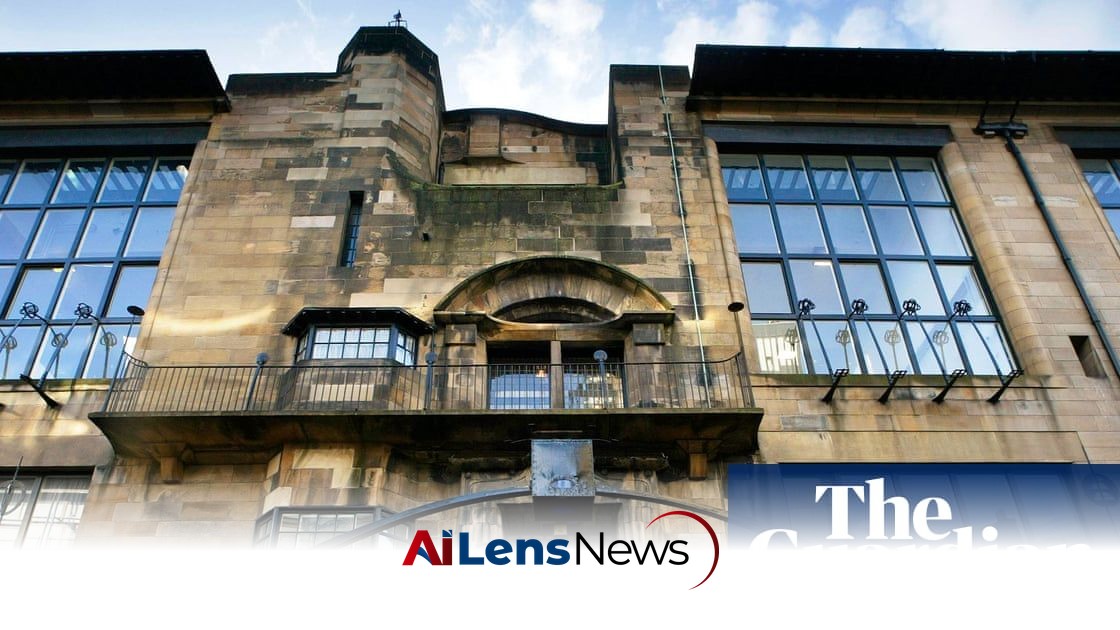


The iconic Mackintosh building at Glasgow School of Art, ravaged by two fires, may not be restored to its original glory due to exorbitant costs, sparking concerns over its heritage.
London, United Kingdom Jul 24, 2026 ALN: Doubly destroyed by two fires, Scotland’s finest piece of architecture, the Mackintosh building at the Glasgow School of Art (GSA), cuts a lamentable sight. This iconic structure, designed by renowned architect Charles Rennie Mackintosh, has become a symbol of both artistic brilliance and tragic misfortune. The building, completed in 1909, is celebrated for its unique blend of art nouveau and Scottish baronial styles, showcasing Mackintosh’s innovative approach to design and architecture.
A 12-year saga of destruction, rebuilding and yet more destruction, all underscored by an unedifying seam of political and institutional wrangling, reached an apologetic conclusion of sorts with the recent announcement that Mackintosh’s exquisite art nouveau creation is unlikely to be rebuilt in its original form due to stratospheric cost. The GSA has faced a myriad of challenges since the initial fire in 2014, which set off a chain of events that have left the future of this architectural masterpiece in jeopardy.
The GSA stated that a full rebuild or “faithful reinstatement” of the burnt-out landmark would cost approximately £265 million. This figure is four times previous estimates and five times the GSA’s annual turnover, raising significant concerns about the feasibility of such a project. The school admitted that it could not afford this comprehensive reconstruction on its own and outlined its current strategy, which focuses on stabilizing the building’s remaining shell and removing external scaffolding. The plastic shroud that has covered the structure will also be removed, allowing the surviving stone walls to be revealed. However, how things progress from this point remains uncertain, with ongoing discussions about the future direction of the restoration.
The cost of the stabilisation work is not yet confirmed, but it is understood to have been covered by a recent settlement with insurers following arbitration. This financial backing is a small relief in the face of the overwhelming costs associated with a full restoration. The fate of the Mackintosh building, considered Scotland’s equivalent of Gaudí’s epic Sagrada Familia in Barcelona or Notre Dame Cathedral in Paris, still hangs precariously in the balance. While Notre Dame, damaged by fire in 2019, has been the subject of a concerted national rebuilding effort that allowed it to reopen five years later, the Mackintosh masterpiece still languishes more than a decade after its first fire and seems no closer to being restored as a functioning art school.
Professional bodies including the Royal Incorporation of Architects in Scotland and the Royal Institute of British Architects have given a cautious welcome to the current interim strategy but emphasized that “faithful reinstatement should remain everyone’s preferred outcome.” In a joint statement, they called for leadership from the Scottish and UK governments to find the necessary resources to ensure the faithful reinstatement of the Mackintosh building and to secure its future as a revitalized creative hub serving Glasgow, Scotland, and the world. They warned that a building of such national importance requires a national response to prevent future generations from lamenting its loss or mutilation.
Labour MSP for Glasgow Paul Sweeney echoed this call, emphasizing the need for a joint venture partnership approach to rebuilding the Mackintosh. He has long campaigned for the full restoration of the building and believes that it is essential for the Scottish and UK governments to provide support for this national project. However, in the current context of a cost-of-living crisis, it remains uncertain whether such resources can or will be found. Sweeney’s plea for a wealthy patron to sponsor the project of a lifetime reflects a growing concern that without significant financial backing, the future of the Mackintosh building may be bleak.
Others have voiced more critical perspectives on the situation. Architect and former GSA lecturer Gordon Gibb stated, “The loss of the Mackintosh building would be catastrophic.” He warned that even a partial rebuild or a soulless facade retention would result in the loss of Glasgow's heritage and further diminish the city's cultural landscape. Gibb argues that failing to rebuild the building as it was originally conceived would compromise its integrity and serve only to highlight the incompetence of those responsible for its temporary custodianship, which ultimately led to its demise.
The entire debacle began with a small fire that broke out during an end-of-year student show in 2014. An aerosol canister of expanding foam placed near a hot projector ignited flammable gases, which spread rapidly throughout the building due to Mackintosh’s arrangement of timber-lined voids and ducts. Despite the initial fire, almost all of the building was saved, leading to a £35 million restoration project that commenced shortly thereafter. Tragically, just weeks before its completion in 2018, the building was gutted by a second fire, marking a devastating turn of events for the GSA and the architectural community.
It is important to understand the significance of Mackintosh’s work within the broader context of architectural history. Cosily familiar to patrons of museum gift shops, it may be difficult to appreciate just how radical and unsettling Mackintosh’s art and architecture were during his time. A temperamental dandy, he drew inspiration from movements in fin de siècle Europe, including art nouveau, Japonism, and symbolism. His oeuvre served as a vibrant challenge to the conventions of Victorian neoclassicism, as he famously criticized the imitation of Greek temples in modern architecture. Mackintosh argued for the necessity of clothing modern ideas in a modern dress, advocating for a distinctively Scottish architectural identity.
Mackintosh’s career was marked by extreme reversals of fortune. In 1900, he enjoyed immense fame, particularly during a trip to Vienna where he and his wife, artist Margaret Macdonald, were celebrated by the secessionist movement. However, the aftermath of World War I severed his connections with Europe, leading to a slow decline into poverty and obscurity. By 1928, Mackintosh had succumbed to mouth cancer at the age of 60, a tragic end to a life that had seen both acclaim and adversity.
If the Mackintosh building is not to be rebuilt as it was originally designed, there are precedents for a strategy that might be described as “curated decay.” This approach involves mixing new and old parts to narrate the wider story of the building. For example, Berlin’s neoclassical Neues Museum lay in ruins for over 40 years after being gutted by wartime bombing until an evocative scheme by architect David Chipperfield transformed its fortunes. Similarly, the Reichstag building in Berlin, remodeled by Norman Foster, retained graffiti scrawled by victorious Russian soldiers, serving as a testament to its tumultuous history.
However, the true glory of the Mackintosh building lies in its holistic design, encompassing everything from door handles to furniture, stained glass to light fittings—all minutely considered by Mackintosh as an exemplary Gesamtkunstwerk, or total work of art. The double destruction of this architectural gem has been nothing short of a disaster, and at present, its potential rebirth as a costly phoenix from the flames feels as distant as ever. The future of the Mackintosh building remains uncertain, and as discussions continue, it is crucial for stakeholders to prioritize the preservation of this irreplaceable piece of Scotland's cultural heritage.
To learn more about the latest developments in Architecture, stay updated with our exclusive reports and analyses on AiLensNews.

