

From runaway caimans to lovestruck swans, Germany's summer 'silly season' stories showcase a unique blend of humor and curiosity.
London, United Kingdom Jul 15, 2026 ALN: Every country has its version of the Sommerloch.
Literally translated, the German word means "summer hole." It refers to that stretch of July and August when parliaments are in recess, everyone is on holiday, and editors discover that the world has stopped producing news.
Another fun German word for the period is Saure-Gurken-Zeit, which literally translates to 'sour pickle time' but refers to the same time of year.
In Britain, the equivalent is known as the Silly Season. In the United States, journalists talk about a slow news cycle or the summer doldrums. The principle is the same everywhere: when hard news takes a holiday, strange stories suddenly become front-page material.
But Germany has arguably gone one step further in naming a very specific sub-category of the phenomenon, the Sommerlochtier or "summer-hole animal."
A Sommerlochtier is rarely just an animal. Instead, it's an escape artist, a menace, a romantic hero, a phantom, a revolutionary, or all five at once.
Arguably, the story of Timmy the Whale falls into this category – from the humanizing nickname to the dizzying €1.5 million rescue effort and the fiercely polarized national debate – everything about the story fits...except for the fact that her story unfolded during Spring.
While this certainly isn’t the only Sommerlochtier story that has ended tragically, others have concluded in a happy ending for their protagonists.
Happy or sad, all of them reveal something about human curiosity – and editorial desperation.
Germany's modern Sommerlochtier tradition arguably begins with Sammy, an 80-centimeter pet caiman whose owner made the questionable decision to take him for a walk on a leash.
When Sammy escaped into a quarry lake in Dormagen near Neuss, the press swiftly promoted him from 'missing exotic pet' to 'aquatic apex predator.'
Media descended, hunters prepared for battle, and nervous swimmers scanned the water for signs of a reptilian menace. After five days of nationwide hysteria, Sammy was caught alive by a diver with his bare hands.
The monster of the deep turned out to be the length of a skateboard.
Kuno was a giant catfish accused of a crime that may never have happened: swallowing a dachshund puppy whole.
No owner ever came forward, no dog was ever conclusively identified – and none of this stopped Germany from collectively losing its mind.
The city of Mönchengladbach split into rival camps, with one demanding "Kuno must not die!" while the other plaintively wondered, "How many more innocent dachshunds must perish?"
A report by a US media outlet compared the hunt to the movie Jaws as anglers and journalists descended on the city's pond in search of the (alleged) dog-devouring monster.
The great hunt ultimately achieved nothing except impressive television ratings. Kuno was never caught, the mystery dachshund remained stubbornly hypothetical, and the story gradually sank back into media sediment.
Then, two years later, city workers pulled a dead catfish – rapidly and widely assumed to be Kuno – from the pond. It measured roughly 1.5 meters and weighed around 35 kilograms.
When the first wild brown bear to enter Bavaria in 170 years crossed the border, Germans initially greeted him like a returning national hero.
Then Bruno began behaving like a bear: eating sheep, raiding beehives, and wandering inconveniently close to villages. As public enthusiasm gave way to official anxiety, Bavarian politicians attempted to manage the crisis through a series of increasingly bureaucratic classifications.
Then-Minister-President Edmund Stoiber explained that bears could be grouped into categories: a Normalbär was a bear behaving normally; a Schadbär was a bear causing damage; and a Problembär was a bear whose behavior had become, officially speaking, a problem.
The soundbite was so widely repeated in the media that the expression Problembär is still used to describe a difficult person or situation.
Supporters hailed Bruno as a symbol of freedom and an outlaw hero, while authorities increasingly treated him as a roaming security threat.
Finnish bear hunters were flown in, a giant bear trap was imported from America, protest movements emerged, solidarity T-shirts appeared, and international newspapers followed every new development.
Finally, after weeks of failed attempts to capture him alive, Bruno was killed by hunters. The decision was hugely controversial, sparking protests, memorials, newspaper tributes, and even threats against those involved in the operation.
Bruno was eventually preserved by taxidermists and put on permanent display in Munich's Museum of Man and Nature.
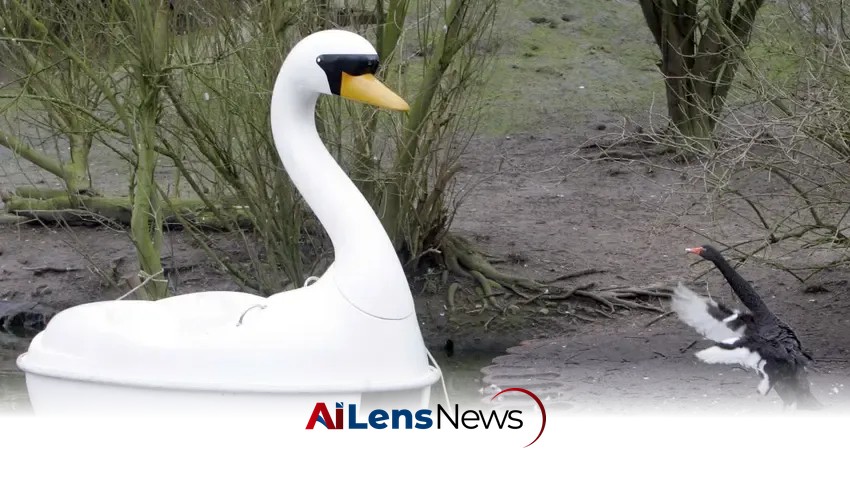
The press went wild in summer 2006 when Petra, a lonely black swan, fell passionately in love with a swan-shaped pedal boat on a lake in Münster.
She followed the object of her affections everywhere, swimming after it whenever tourists hired it out and defending it with jealous intensity. The romance became so serious that when the pedal boat had to be moved into winter storage, Petra accompanied it to Münster Zoo.
Twenty-three media organizations reportedly turned up to cover the relocation of a swan and her fiberglass soulmate. For nearly two years the press chronicled every development, from the DNA test that revealed "Schwarzer Peter" was actually female and should be called Petra, to her eventual decision to leave the pedal boat for a flesh-and-blood swan named Paul. That relationship failed too.
Petra then vanished entirely, only to reappear years later at a stork rehabilitation center – older, but hopefully wiser.
Destined for slaughter, Yvonne the cow achieved worldwide fame when she escaped into a Bavarian forest and spent months on the run.
For 98 days she evaded trackers, hunters, helicopters, thermal-imaging cameras, and an ever-expanding cast of would-be rescuers. Attempts to lure her out included her sister Waldtraut, a dachshund named Mirko, and a breeding bull called Ernst who had been recruited as a romantic decoy.
As the chase dragged on, newspapers marveled at Yvonne's apparent ability to adopt the habits of local deer. Fans printed "Freedom for Yvonne" T-shirts, songs were written in her honor, and media outlets from as far away as India campaigned to save her from a shoot-on-sight order.
By the end of the summer, she was no longer a runaway cow but a four-legged folk hero, routinely described as "the cow who wanted to be a deer."
In the end, Yvonne was finally captured alive. She was spared the slaughterhouse, retired to an animal sanctuary, and lived out her days as one of Germany's most successful celebrity fugitives.
In July 2023, a shaky six-second video convinced much of Germany that a lioness was stalking the leafy suburbs of Berlin.
As a result, hundreds of police officers armed with submachine guns, as well as hunters, vets, helicopters, and armored vehicles, descended on the area in search of an escaped apex predator.
Residents were advised to stay indoors, open-air events were moved, and social media became consumed with speculation about the lioness's origins, motives, and whereabouts.
The evidence for all this excitement remained remarkably slender. No zoo, circus, or private owner reported a missing lion. In fact, inspections revealed that every registered lion in the region was exactly where it was supposed to be. Nor were any lion tracks found.
Eventually, people began listening to the experts pointing out that the animal in the video looked suspiciously like a wild boar.
After two days of wall-to-wall coverage, officials rather sheepishly called off the search.
To learn more about the latest developments in Visual Arts, stay updated with our exclusive reports and analyses on AiLensNews.

