

Exploring the remnants of the 1988 Glasgow Garden Festival, designer Lex Lamb reflects on its legacy amidst overgrown landscapes and forgotten structures.
London, United Kingdom Jul 12, 2026 ALN: We’re hunting for history today but nature is getting in the way. The rhododendron, hawthorn, reeds, and weeds have taken over here, but underneath it all is the remains of one of the most memorable centrepieces of one of the most iconic events in the history of Glasgow. We push our way through and there it is, partly buried, mostly hidden, largely forgotten: steps from nowhere to nowhere.
My guide, the designer and writer Lex Lamb, says this is all that’s left of the waterfall. He describes how it would have looked back then, in the 80s: a cascade of water down a gentle slope and onwards to a burn. Nearby was a distillery where you could sample the best of Scotch whisky, and a restaurant serving salmon mousse, breast of duck with an orange and Drambuie sauce, and Scottish cheeses with oatcakes: three courses plus coffee and mints for £13.95. After lunch, you could go for a wander along the water and spot a floating tap and a giant yellow kettle and other Carrollian wonders.
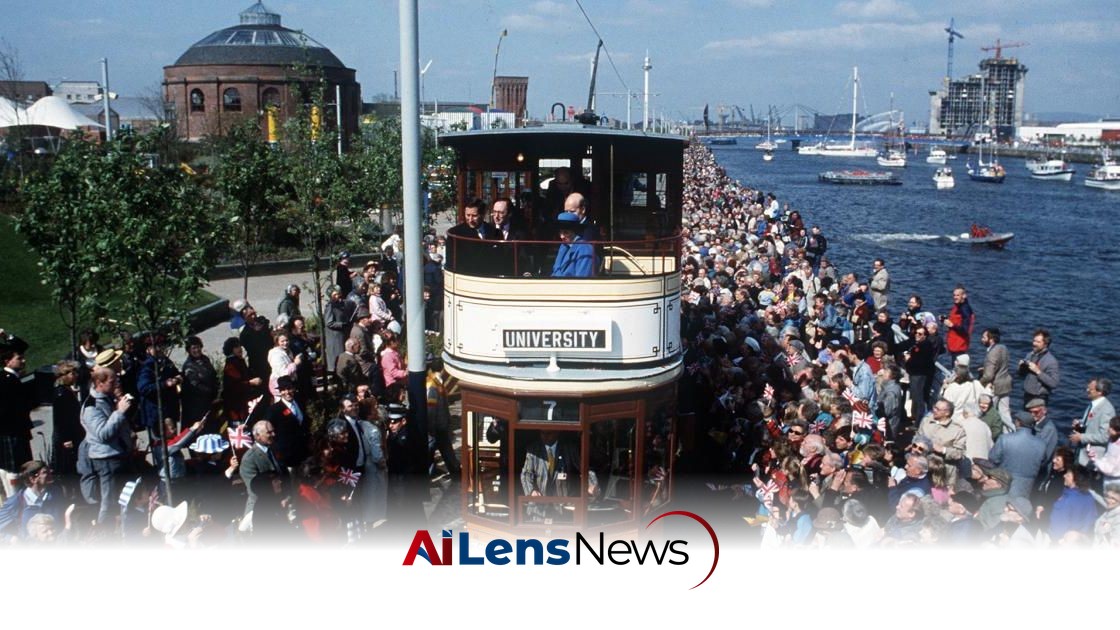
There’s a good chance you’ll remember some, or all, of this if you were in Glasgow in the summer of ‘88. Over the course of the Garden Festival – from April 29 to September 26 – 4.3 million people visited, 20,000 -30,000 a day, making it the most successful of the UK’s five garden festivals. Glasgow’s was built over 120 acres on Prince’s Dock in Govan and it happened during what now looks like one of the most extraordinary periods in the city’s story, a cultural and commercial flowering: The Burrell Collection and Tramway opened, the SECC and the Concert Hall, Princes Square was new, and the Italian Centre and the St Enoch Centre, the city was about to become European Capital of Culture and a promotional campaign on every wall and every bus said Glasgow’s Miles Better, and it felt that way.
But what happened? The spot Lex Lamb and I are standing on is one of the few remnants of the festival; everything else was dismantled or covered up or lost or scattered to the four corners of the country. A while ago Lex Lamb started to wonder what happened to the stuff – the public art, installations, and other structures – and it led to the establishment of a group of enthusiasts calling themselves After The Garden Festival. Now it’s led to a new book that’s led to the walk through history we’re doing today.
Lex explains how it came about. “It started off in a conversation on Twitter about what happened to the stuff at the festival,” he says, “then I started getting feedback from people who remembered things and that was how After the Garden Festival started because A, it was important in the history of Glasgow, B, it was very warmly remembered, and C, it wasn’t being recorded.”
His new book is part of an effort to do the recording of the festival and in a way recreate it. “If you didn’t visit the festival, you can read the new book and get a sense of what it was like. I liked the idea that you could start to walk round it again.” So that’s what we’re going to do: walk round it again and answer some big questions. What was it like? Why did some people not approve? What happened to all the stuff? And most importantly: was it worth it?
First stop: the waterfall
We’re standing on the site of the old waterfall and Lex is explaining how it started. He points across the trees towards what is now The Village hotel and BBC Scotland. “All this was the festival,” he says, “but before that it was docks, serviced by a network of rail tracks. You were dealing with a flat site and a lot of the challenge was how to raise people above it, so a pile of material was brought in to lift it up. The idea was you start with the ‘seaside’ by the Clyde and build up towards the ‘Scottish Highlands’ where we’re standing now. This was the highest point.”
The area with the waterfall was called the ‘Landscape and Scenery Zone’, one of seven themed areas linked by paths, a railway, and tramlines. The landscape architects, William Gillespie & Partners, visualised the entire site as a flower with visitors passing through the stem to the centre and on to the ‘petals’, or themed areas. It owed a lot in its design to Disney’s Magic Kingdom.
Lex reminds me, though, that the flower-shaped theme park came, in a way, out of violence and conflict. It was the Germans who pioneered the idea of Federal Garden Shows in the 1950s as a way to regenerate areas hit by the Second World War and the idea came up again in the UK in the 1980s as a way of trying to revive parts of the country in industrial decline. The Thatcher government hummed and hawed but it was the Toxteth riots in ’81 that finally convinced them to support the idea and choose the location for the first one: Liverpool. It opened in ’84, with Glasgow following four years later.
From the start, the UK model was always about being a temporary exercise – as a spur to private enterprise doing the longer-term regeneration – which is why the spot we’re standing in now, at what was once the waterfall, is unique. When the festival was over, a decision was made to retain much of the zone and convert it into a park, which is what it still is today. Decades on, Festival Park is a beautiful little pocket of green amid the brown and the grey.
The park is also central to the story of what happened to one of the major pieces of art linked to the festival. Lex tells me it was decided a piece by the American sculptor George Rickey, Three Right Angles Horizontal, would form the centrepiece of the lake in Festival Park but within a week people were climbing over it and it got damaged and was put into storage to become one of the many pieces of festival art that effectively disappeared. Eventually, some 30 years later, a home was found for it when it was installed in the duck pond at Queen’s Park in 2020, where it still is.
Second stop: the bridge
We’re moving on from the park, across Govan Road and down towards the river and Bell’s Bridge. A new pedestrian crossing over the Clyde was part of the concept from the start and it was the main entrance to the site for people parking at the SECC. The £250,000 cost was covered by Arthur Bell Distillers, hence the name which it still bears to this day.
We stand on the bridge, rain clattering off the canopy, and talk about the sunny day in April 1988 when the festival opened and the first people streamed over the bridge (£5 for adults, £4 for kids) although Lex thinks it’s right to point out that not everyone was on board with the idea. In fact, in 1983, the then Glasgow District Council’s policy and resources committee decided nine-to-seven that the cons of hosting a festival outweighed the pros and the city should not submit a bid. Fortunately, the decision was overturned by a meeting of the full council.
Lex says there was some scepticism among local people too, but the offer of free tickets to a preview day for the citizens of Govan, Kinning Park, and Tradeston helped win them over. Many locals were also starting to see what the festival could do to help change the image of Glasgow, still lumbered with the clichés of crime and dereliction.
“The festival had aspirations possibly in the noble 20th-century tradition of ‘give people beautiful things and it will elevate them’ – there was a bit of that going on,” says Lex. “But it wasn’t done in an exclusive way – anyone could turn up. And this was the first time that people could sit and have a drink outside. One of the things I remember about the festival was that I sat and had a pint outside. I’d seen people doing that on family holidays abroad, now everybody sits outside pubs in Glasgow. But the festival was the first taste in Glasgow for a lot of things that have now become commonplace.”
Third stop: the bollards
We’ve walked down the river a bit to look at what Lex tells me is one of the most resilient physical remnants of the festival and I’m having a flashback. There are some semi-detached houses behind us and I’m remembering going to a party in one of them in the early 90s when the houses were the only thing here. It was just a few years after the festival at that point and much of the promised regeneration had yet to happen. Nearly 40 years on, much of it still hasn’t.
But here we are at what Lex wants to show me: a row of bollards. He sits himself down on one of them. It’s still painted in black and white stripes, the work of French artist Daniel Buren. Buren was commissioned to create a work for the festival and came up with 170 repurposed dockyard bollards, including some new ones made for the occasion. Around 75 of them still survive, including ones still used to moor the paddle steamer Waverley.
You may remember that it was on this spot by the river that you had the ‘Recreation and Sport’ zone and the ‘Science and Technology’ zone, which included the Clydesdale Bank Anniversary Tower, with its rotating observation deck, and the Coca-Cola rollercoaster. After the festival was over, the tower was moved to Rhyl in Wales and the rollercoaster went to Pleasurewood Hills theme park in Lowestoft where it’s still doing its thing.
The yellow kettle and the floating tap were also in the Science and Technology zone: the kettle ended up on Gourock Pier before being dismantled in the late 90s; while the tap, like a lot of other items from the festival, disappeared somewhere, no one knows quite where. Having researched the subject, Lex thinks that, of the 230 or so objects that were erected and installed on the site, the final destination is known for only about 40 to 50 of them.
Lex says the rollercoaster was central to the festival concept from the start as a way of convincing the public that the garden festival would be more than a horticultural event, but the impression that a theme park was being built on Govan’s docks didn’t help win over some of the dissenters. The poet Liz Lochead went on TV to read a poem in which she suggested that the events at Prince’s Dock were “making Scotland just a theme park / A dream park / A Disneyland where work disnae exist / And only tramcaurs / Kelvingrove dinosaurs / And big rusting skeletons of cranes persist.”
Opposition also came from Workers City, a collective of writers, activists, and artists formed in 1988 in response to the urban regeneration projects like City of Culture and the Garden Festival. One of Workers City’s publications said “the great thing about flowers is that they keep coming back, year after year. But once the cranes and the ships and the jobs have gone, they never seem to come back do they?” Lex also quotes Elspeth King, curator of the People’s Palace: “She said she couldn’t think of a single object at the festival that was of high art value.”
Some of the issues the critics raised are still around today, such as the idea of gentrification and the middle-class coming in and changing an area without real benefits for the local people. But one of the most striking aspects of Lex’s history is the fact that 2,000 unemployed people were recruited and trained to work at the festival and all but 200 were found permanent jobs afterwards. “The organisers did acknowledge and think about the fact that they were inserting themselves into the community,” says Lex. “And the way they handled the staff was pretty good.”
Fourth stop: the houses
On to the fourth stop now: the huge pyramidical flats on the bank of the Clyde at the eastern end of the site. They won’t be to everyone’s taste and certainly betray their 80s origins, but Lex has grown to rather like them. They represent, he says, a peak moment of post-modern, pastel-coloured 80s design, and are one of the solid examples of the garden festival’s longer-term legacy.
Lex says it was always envisaged that a large part of the site would become housing after the festival was over. Most of the 120 acres was owned by the housebuilders Laing, so the Scottish Development Agency, which spearheaded the festival, agreed to lease the site from them for £1 million and secure other plots of land for the company so their housebuilding programme could continue. For critics who saw the festival as overly commercial in the first place, it was a controversial arrangement.
It hasn’t helped that less of the site has ended up being housing than was intended. In 1995, the Glasgow Development Agency took on responsibility for the area and came up with a set of proposals, most of which came to pass: the IMAX cinema, the Glasgow Tower and the Science Centre, and longer term the BBC Scotland headquarters, the Village hotel, and new housing adjacent to Festival Park. But if the walk with Lex today has shown anything, it’s that a lot has changed for the better on the site and a lot hasn’t changed at all: swathes remain undeveloped.
Last stop: the mural
The last physical reminder of the festival we’re looking for is one you could easily miss. Turn off Paisley Road West onto Mavisbank Gardens and go halfway down the hill and there it is, on the gable end of a tenement: the logo of the 1988 Glasgow Garden Festival. Created by Shona MacIver of the Westpoint design agency, the flower logo was everywhere in ’88, and 35 years on, in drawers and cupboards all over the city, it’s on the mugs and badges and tie-pins that people bought as souvenirs.
The site of the mural, right on the edge of the old festival site, seems like a good place to talk to Lex about its final legacy. Looked at in some ways, the event should probably be judged a failure: it was described as the UK’s largest consumer event but it didn’t make a profit and the decision was made that Glasgow would be the last of the garden festivals.
Lex’s view is that the legacy is mixed. He says it was never intended to be permanent so it’s unfair to judge it that way, but points out that some of the regeneration has taken a very long time. “One miraculous thing the festival achieved,” he says, “was people putting aside their differences and getting on board with something that could be perceived as being a Thatcherite project.” But he’s doubtful something like the garden festival could happen now.
To learn more about the latest developments in Heritage & History, stay updated with our exclusive reports and analyses on AiLensNews.

