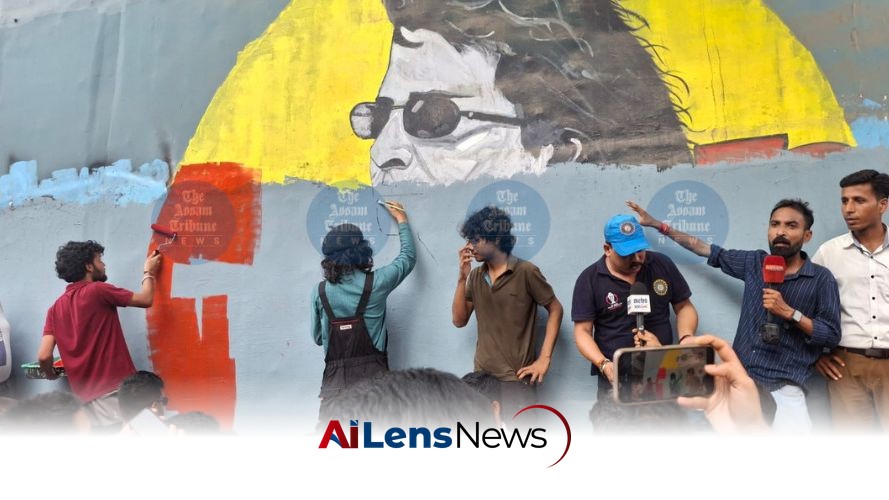


CM Himanta Biswa Sarma defends the removal of a Zubeen Garg mural, emphasizing the need to commemorate the 2008 blast victims instead.
Itanagar, India Jul 10, 2026 ALN: Chief Minister Himanta Biswa Sarma on Friday defended the removal of the controversial Zubeen Garg mural at Ganeshguri, asserting that the government had not ordered its erasure and arguing that the site should instead commemorate the victims of the 2008 Ganeshguri serial blasts.
Addressing the issue during a post-budget press conference at the Central Hall of the Assam Legislative Assembly, Sarma said the controversy had been unnecessarily politicized and accused certain groups of creating a false narrative that the government had deliberately removed a portrait of the late music icon.
"The government did not remove the mural. I have statements from the two painters who erased it. They themselves said the image did not resemble Zubeen Garg, and that is why they removed it. They are Assamese boys, not Muslims as some have tried to portray. Even the contractor is Assamese, and all three are ardent fans of Zubeen Garg. They simply felt the painting was not a proper likeness of him," Sarma said.
The Chief Minister said the issue had exposed the need for a proper system governing public portraits of eminent personalities.
"If an institutional portrait of Zubeen Garg is to be painted, the family should first release approved reference photographs. Garima Garg can identify and officially release three or four photographs that artists may use. Otherwise, everyone will paint according to their own imagination, resulting in distorted images that do not do justice to his legacy," he said.
Referring to similar controversies over portraits in Tezpur and Barpeta, Sarma said social media outrage had highlighted how inconsistent depictions of the singer had become.
"There are different distorted images of Zubeen in different places. Fans themselves are unhappy. Let the family and the Zubeen Garg Foundation finalize the photographs so that every portrait reflects the dignity he deserves," he said.
However, Sarma stressed that the more important issue was the location chosen for the mural.
"The place where the Zubeen Garg portrait was painted in Ganeshguri is not just another wall. It carries the painful memory of the 2008 serial blasts. The blood of Assamese people is associated with that place. Instead of painting Zubeen there, that wall should carry portraits of the 15 people who lost their lives in the blasts or artwork remembering the fight against terrorism," he said.
Calling it a site of collective public memory, the Chief Minister said such locations should be treated with sensitivity.
"Every place has its own significance. Ganeshguri should remind people of the tragedy that took place there. That is the appropriate theme for that location," he said.
At the same time, Sarma made it clear that he had no objection to murals celebrating the life and legacy of Zubeen Garg, provided they were created through a structured process.
"If people want to honor Zubeen, let them seek permission. We can allocate gallery spaces under flyovers. Chandmari flyover, for instance, can have an entire gallery depicting Zubeen's life from his childhood to his final years with 10 or 12 beautifully executed portraits. The Chief Minister himself will go there and paint if required. We have no enmity against Zubeen Garg," he remarked.
Sarma also criticized the Students' Federation of India (SFI), alleging that members of the organization had opposed the construction of several flyovers but were now using those same structures for public art.
"Those who protested against the Bharalumukh flyover and the removal of trees near Dighalipukhuri are now painting portraits on those flyovers. They cannot oppose the projects and later use them for publicity. Either protest against the flyovers or accept them. You cannot do both," he said.
The Chief Minister announced that he had instructed all Deputy Commissioners and Superintendents of Police not to permit unauthorized paintings on flyovers.
"I have directed all DCs and SPs that if SFI members paint on flyovers without permission, they should be arrested. Public infrastructure cannot become a canvas for political groups," he said, adding that artists must obtain permission from district authorities and work with recognized art institutions.
According to Sarma, future public murals should be planned in consultation with artists, the government, and the families or organizations associated with the personalities being depicted.
"Art colleges should adopt flyovers and create thematic galleries. One flyover can celebrate Bhupen Hazarika, another Jyotiprasad Agarwala, another Jayanta Hazarika. That is how public art should evolve with proper planning, quality, and respect," he said.
Responding to criticism that the government had remained silent when the mural was first painted, Sarma said restraint had been exercised because of the anticipated visit of the Japanese Prime Minister to Guwahati.
"People mistook our silence for weakness. We deliberately avoided action because the Japanese Prime Minister was expected to visit Assam, and we did not want any disturbance. Unfortunately, that visit was later canceled, which was a major setback for me. But our restraint should never be interpreted as fear," he said.
Rejecting allegations that the government was hostile towards Zubeen Garg, Sarma pointed to several initiatives undertaken in the singer's memory.
"The government has done everything possible to honor Zubeen from constructing the Samadhi Kshetra to establishing a special fast track court for his justice. Why would we remove his portrait? The narrative that the government erased it is completely false," he said.
The Chief Minister reiterated that while Assam should celebrate Zubeen Garg's unparalleled contribution to its cultural identity, public memorials and murals must follow an organized process that respects both artistic standards and the historical significance of public spaces.
"The way we honor Bishnu Rabha, Jyotiprasad Agarwala, and Bhupen Hazarika is the way Zubeen should be honored with dignity, proper planning, and public respect," he said.
To learn more about the latest developments in Heritage & History, stay updated with our exclusive reports and analyses on AiLensNews.

