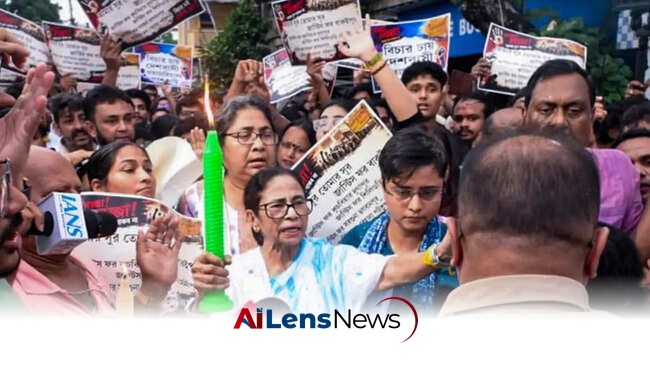


Mamata Banerjee accused the BJP of disrupting her party's protest march, alleging police bias and violence against Trinamool Congress workers.
New Delhi, India Jul 8, 2026 ALN: Kolkata: Trinamool Congress (TMC) supremo Mamata Banerjee on Wednesday accused the Bharatiya Janata Party (BJP) of disrupting her party's protest march over the tragic rape and murder of an 11-year-old girl in Baruipur. This incident has not only drawn widespread condemnation but has also reignited discussions about safety and justice for women and children in West Bengal. Banerjee alleged that the police acted as an "arm" of the BJP, failing to uphold the Calcutta High Court's order that permitted the rally. The tension between the two political parties has been palpable in West Bengal, especially as the state prepares for upcoming elections.
The protest march was intended to highlight the urgent need for justice in the case of the young victim, whose death has shocked the local community and prompted a broader public outcry regarding the safety of women and children in the region. Such incidents of violence against minors have, unfortunately, become all too familiar in India, leading to intense debates about the effectiveness of law enforcement and the judicial system in protecting vulnerable populations. The tragic nature of this case has served as a catalyst for political mobilization, with parties seeking to leverage public sentiment surrounding women's safety.
Addressing a gathering at Hazra Crossing in south Kolkata after the culmination of the protest march, Banerjee claimed that BJP supporters obstructed the rally and assaulted TMC workers at various locations along the route. "The high court allowed our rally, but BJP goons stopped it. How can the police undermine the court's order allowing the rally? BJP goons beat up our party workers. Is this democracy?" she stated. The accusation of police bias is a serious one, as it raises questions about the impartiality of law enforcement in politically charged environments. The role of police in maintaining order during protests is critical, and allegations of partisanship can significantly undermine public trust in these institutions.
During the rally, clashes erupted between BJP and TMC youth wing members, prompting police personnel to baton charge in an attempt to control the situation. The protest, organized by TMC youth workers, began from Ballygunge Phari in southern Kolkata and faced repeated interruptions from BJP workers, who raised slogans and attempted to set up human barricades along the route. These altercations reflect a broader trend of increasing political violence in the region, where party workers often clash over political ideologies and electoral strategies. Such confrontations not only disrupt public order but also contribute to an atmosphere of fear and uncertainty among citizens.
Banerjee criticized the police for failing to perform their duties impartially, asserting that they had become an "arm of the BJP organization." This allegation comes at a time when the relationship between the police and political parties is under scrutiny, particularly regarding the enforcement of law and order during protests. The perception of police neutrality is essential for maintaining democratic norms, and any deviation from this expectation can lead to significant public backlash. As political tensions escalate, the role of law enforcement becomes increasingly complex, as they are often caught between conflicting party interests.
Furthermore, Banerjee alleged that she was under constant surveillance by the police, likening her situation to being under house arrest. "I am being kept under police watch as if I am under house arrest," she claimed. This statement raises concerns about the extent of state power and its implications for political dissent in West Bengal, a state known for its vibrant political culture but also for its history of political repression. The ability of political leaders to operate freely is a cornerstone of democratic governance, and any perceived infringement on this freedom can lead to widespread discontent among the populace.
In a pointed attack on the BJP, Banerjee accused them of creating disturbances in the name of Lord Ram, stating, "Those who looted donations for the Ram Temple are creating disturbance here in the name of Lord Ram." This statement underscores the BJP's use of religious sentiments as a political tool, which has been a hallmark of their strategy in various states across India. The BJP's approach often involves mobilizing religious identity to galvanize support, which can exacerbate existing societal divisions and lead to further polarization within the electorate.
The incident highlights the ongoing tensions between the TMC and BJP in West Bengal, particularly in the wake of sensitive issues that resonate deeply with the public. The tragic case that sparked this protest has drawn attention not only to the need for justice for the victim but also to broader issues of women's safety in the state. The public outcry over such incidents often leads to political mobilization, with parties seeking to capitalize on public sentiment to bolster their support. This dynamic can create a cycle of political opportunism, where parties leverage tragedies to advance their agendas, potentially at the expense of genuine advocacy for change.
As political rivalries intensify, the implications for governance and public safety remain a pressing concern. The clash during the protest march underscores the volatile political climate in West Bengal, where allegations of police bias and political violence continue to shape the narrative. The TMC and BJP have been engaged in a fierce battle for political supremacy in the state, with each party accusing the other of undermining democracy and the rule of law. This adversarial relationship complicates efforts to address pressing social issues, as both parties may prioritize political gain over collaborative problem-solving.
The political landscape in West Bengal is characterized by a history of ideological battles, particularly between the left-leaning parties and the right-wing BJP. The TMC, which has been in power since 2011, has faced increasing challenges from the BJP, which has made significant inroads in the state in recent elections. The BJP's rise in West Bengal can be attributed to various factors, including a shift in voter demographics and growing dissatisfaction with the TMC's governance. This ongoing rivalry is not merely a contest for power but also reflects deeper societal divisions and differing visions for the state's future.
The implications of such clashes extend beyond immediate political gains or losses. They can affect the public's perception of safety and governance, potentially leading to increased polarization among the electorate. As citizens witness political violence and allegations of police partisanship, trust in governmental institutions may erode, further complicating the political landscape. The erosion of trust can have long-term consequences, as it may lead to increased apathy among voters and diminished civic engagement, undermining the democratic process.
In conclusion, the clash during the protest march underscores the volatile political climate in West Bengal, where allegations of police bias and political violence continue to shape the narrative. The tragic incident that sparked the protest serves as a reminder of the urgent need for effective governance and the protection of vulnerable populations. As the political situation evolves, both the TMC and BJP will need to navigate these challenges carefully, as the stakes are high not only for their respective parties but also for the citizens of West Bengal who seek justice, safety, and a stable political environment. The resolution of these tensions will require a commitment to dialogue and a genuine effort to address the underlying issues that fuel political conflict, as well as a concerted effort to restore public confidence in the institutions that are meant to serve and protect them.
To learn more about the latest developments in Corporate & Industry Insights, stay updated with our exclusive reports and analyses on AiLensNews.

