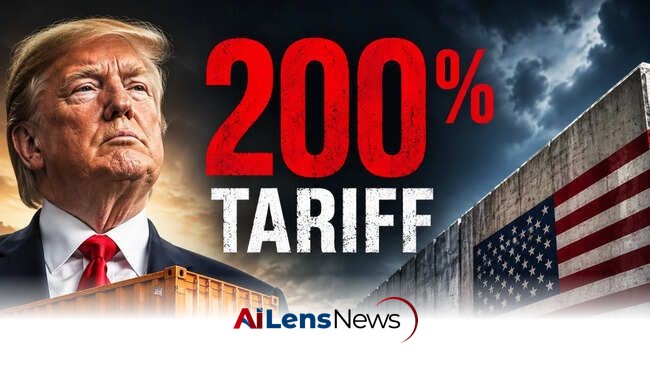


Donald Trump's proposed 200% tariff on generic drug imports raises concerns for Indian pharmaceutical companies, but experts suggest the long-term impact may be limited due to India's cost advantages and the complexities of reshoring manufacturing.
New Delhi, India Jul 22, 2026 ALN: US President Donald Trump's recent announcement regarding a proposed 200% tariff on imported generic medicines has ignited significant concerns within the Indian pharmaceutical industry. Under this plan, generic drugs entering the United States would initially face no tariffs for two years, followed by a 100% tariff for one year, and then escalating to 200% thereafter.
The United States imported approximately $213 billion worth of pharmaceutical products in 2025, including $94.1 billion of finished medicines, which encompasses generic drugs. India is particularly vulnerable, exporting $25.8 billion in pharmaceuticals globally in 2025, with $9.7 billion, or 37.7%, directed to the US, making it the largest market for Indian pharmaceutical exports. Indian companies account for 47% of all generic prescriptions dispensed in the US, solidifying India's position as a primary supplier of affordable generic medicines.
The proposed tariffs pose a daunting challenge for Indian pharmaceutical companies, which may be compelled to shift manufacturing operations to the US, a move fraught with business risks. However, the intricacies of generics manufacturing and existing supply chains suggest that the actual impact of these tariffs may not be as severe as initially feared. Financial analysts from Motilal Oswal argue that the complexities involved in the generic drug business make such a transition far more challenging than it appears.
In addition, the potential for increased operational costs due to the tariffs could lead to a reevaluation of business models for Indian pharmaceutical companies. This may include exploring alternative markets or adjusting pricing strategies to mitigate the impact of tariffs. The long-standing relationships that Indian manufacturers have built with US healthcare providers and distributors over the years could also play a crucial role in determining their ability to weather the storm created by these tariffs.
Trump's tariff initiative is part of a broader strategy aimed at revitalizing pharmaceutical manufacturing in the US. By imposing substantial tariffs on imported medicines, the expectation is that companies will be incentivized to establish manufacturing facilities within the country. Additionally, this move resonates politically, as reducing drug prices and decreasing reliance on foreign manufacturing are key issues for many American voters, particularly older demographics who are significant consumers of prescription medications.
The lengthy phase-in period for the tariffs allows Trump to project a tough stance on pharmaceutical imports while deferring the challenging consequences of this policy. The real question remains whether this measure will successfully lead to a substantial reshoring of generic drug production. The effectiveness of such a reshoring strategy hinges not only on tariffs but also on the ability of US manufacturers to compete with the established efficiencies of Indian production.
One of the primary challenges to reshoring is the significant cost differential between India and the US. Indian manufacturers benefit from a structural cost advantage estimated at 40-60%. This advantage has made Indian production a preferred choice for many global pharmaceutical companies for years. In a highly competitive market for generic medicines, even minor increases in manufacturing costs can drastically impact profitability.
If tariffs are applied to all imported generic medicines, the challenge will not be exclusive to India; all overseas suppliers will face similar hurdles. Consequently, the competitive landscape may not shift dramatically, as importing from India could still be a viable option even after factoring in higher costs associated with tariffs. Furthermore, the potential for Indian manufacturers to innovate and improve efficiencies in production processes may mitigate some of the tariff-induced cost increases.
Another crucial aspect of the tariff proposal is the time required to develop alternative manufacturing capabilities. Unlike consumer products, drug manufacturing involves extensive regulatory processes. After constructing a pharmaceutical facility, it must pass regulatory inspections, and individual products must undergo approval before they can be marketed. This can take several years, which complicates the timeline for any potential reshoring efforts.
This means that even if companies decide to establish new manufacturing facilities in the US today, it could take years before they can effectively compete with existing Indian production. The proposed two-year window before any tariffs take effect reflects the reality that pharmaceutical supply chains cannot be relocated overnight. Moreover, the established supply chains that link Indian manufacturers with raw material suppliers, regulatory bodies, and distribution networks would take considerable time to replicate in the US.
The dynamics of the generic drug market present additional complications for any reshoring strategy. Generic drugs account for about 90% of prescriptions dispensed in the US but represent only a small fraction of overall drug spending due to their already low prices. Manufacturers fiercely compete for market share, leaving little room to absorb significant cost increases. As a result, the mere threat of tariffs may not trigger a mass migration of generic drug manufacturing to the US.
Any increase in production costs must ultimately be absorbed somewhere—whether through rising prices, shrinking margins, or reduced attractiveness of certain products for manufacture. This creates a political dilemma for Trump, who aims to be perceived as lowering drug costs for American consumers. However, if generic manufacturers face substantially higher costs due to production shifts to the US, those costs could ultimately be passed on to consumers.
Furthermore, the potential for increased prices could lead to a backlash from the very voters that the tariff proposal is intended to help. If healthcare costs rise due to tariffs, it could undermine public support for the initiative and create a complex political landscape for the Trump administration.
In conclusion, while the proposed tariffs present significant challenges for Indian pharmaceutical companies, the long-term impact may be mitigated by India's cost advantages, the complexities of drug manufacturing, and the realities of the global pharmaceutical market. The interplay between regulatory hurdles, cost differentials, and market dynamics will ultimately shape the future of pharmaceutical manufacturing in both India and the US.
As stakeholders in the pharmaceutical industry monitor developments closely, the potential for negotiations, adjustments, and adaptations will play a critical role in determining the outcome of this tariff proposal. The evolving landscape of global trade, regulatory environments, and consumer expectations will continue to influence the strategies adopted by pharmaceutical companies in response to these tariffs, highlighting the intricate balance between policy initiatives and market realities.
To learn more about the latest developments in Financial Literacy, stay updated with our exclusive reports and analyses on AiLensNews.

