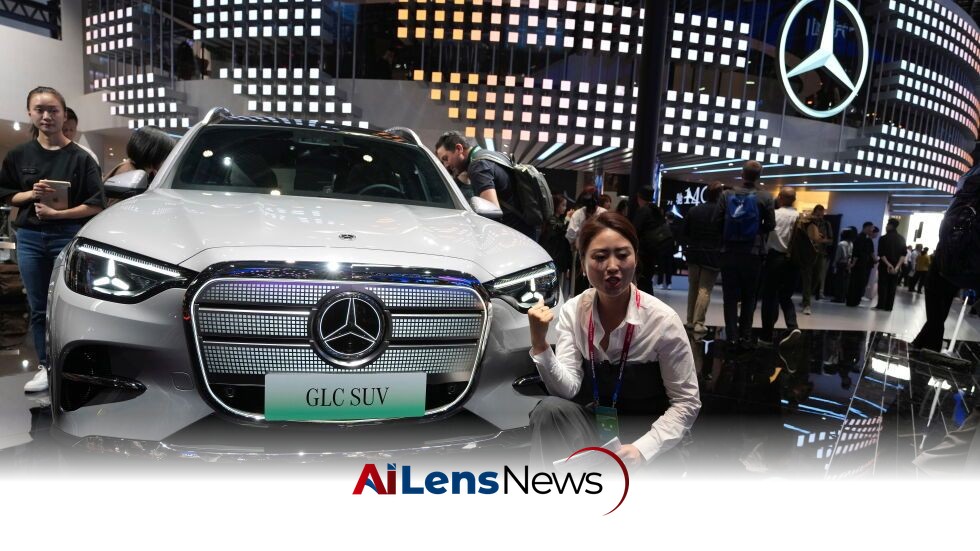


Major German car manufacturers report steep sales drops in China, highlighting intensified competition and weakening domestic demand in the world's largest auto market.
Washington DC, United States Jul 12, 2026 ALN: HONG KONG — Major German carmakers have recently reported substantial quarterly sales declines in China, a market that has long been considered crucial for their growth. The decrease in demand is attributed to a combination of factors including a slowing economy, weakened consumer sentiment, and increased competition from domestic Chinese automakers.
During the April to June quarter, leading German brands such as Volkswagen, Mercedes-Benz, BMW, and Porsche experienced sales contractions ranging from 30% to 41% compared to the same period in the previous year. This trend is not an isolated incident; for the first half of the year, all four manufacturers reported a decline of over 20% in their sales figures in China, a market that has historically been one of their most significant revenue sources.
The ramifications of these sales declines are profound, affecting not only the immediate financial performance of these companies but also their broader strategic positioning in the global automotive market. The falling sales in China have put pressure on their overall profits, with some companies reporting that gains from other regions were insufficient to offset the losses incurred in China. This highlights the crucial role that the Chinese market plays in the global strategies of these auto manufacturers.
In the context of increasing competition, German carmakers are not only facing challenges within China but are also contending with a rising tide of Chinese brands making inroads into foreign markets, including Europe. Brands like BYD have begun to establish a foothold outside of China, further intensifying the competitive landscape for traditional automakers. This shift signifies a potential transformation in consumer preferences, as more buyers are drawn to the affordability and innovation offered by Chinese automakers.
Analysts have noted that the latest quarterly sales declines represent some of the steepest downturns for German automakers in the Chinese market. For instance, Volkswagen Group reported a staggering 36.6% drop in deliveries in China, amounting to 424,300 vehicles during the quarter. This decline not only impacted their sales in China but also contributed to an overall global sales decrease of 8.6%, despite increases in other regions such as Europe and the Americas.
In response to these challenges, Volkswagen has announced plans to reduce its model lineup by up to half, a significant move reflecting the drastic changes in consumer demand and market conditions. This decision underscores the urgency with which these companies are trying to adapt to a rapidly evolving automotive landscape.
The backdrop to these declines includes a prolonged downturn in China’s property sector, which has negatively influenced consumer sentiment. Many potential buyers are now hesitant to make large purchases, opting instead for more affordable options. In addition, the fierce competition in China’s domestic car market has led to a protracted price war, further squeezing profit margins for many European carmakers. As consumers increasingly gravitate towards budget-friendly Chinese brands, foreign companies are finding it increasingly difficult to maintain their market shares.
Porsche, which is part of the Volkswagen Group, has characterized the current market environment in China as “challenging.” Similarly, Mercedes-Benz has acknowledged that the country is experiencing a “significantly weaker overall market and macroeconomic environment,” suggesting that the difficulties are not merely cyclical but may reflect deeper structural issues in the market.
The China Association of Automobile Manufacturers reported that passenger car sales in the country fell by 24% in the first half of the year, totaling nearly 8.3 million vehicles. This decline is indicative of a broader trend affecting the automotive industry in China, as consumer preferences shift and economic conditions fluctuate. Consultancy AlixPartners has projected that sales of light vehicles, which include passenger cars, in China may fall by approximately 10% for the entirety of the year, further compounding the challenges faced by foreign manufacturers.
As Chinese brands continue to gain favor among consumers, foreign automakers will likely need to engage in a fierce battle for market share. Stephen Dyer, the Asia-Pacific leader of the automotive practice at AlixPartners, emphasized that foreign automakers must now contend with a landscape where they must "fight for every share of (the) market." This sentiment reflects the urgency of the situation and the need for strategic pivots among established brands.
Moreover, the competitive landscape is shifting as Chinese carmakers are typically more agile in updating their model lineups than their foreign counterparts. This nimbleness allows them to respond more effectively to changing consumer preferences and market demands. Chris Liu from the research and advisory group Omdia noted that German automakers are still predominantly focused on internal combustion engine vehicles, such as gasoline cars, while electric vehicle (EV) sales in China are outpacing those of conventional fuel vehicles. This misalignment with market trends places German manufacturers at a disadvantage, especially as the Chinese market increasingly favors EVs.
As the situation evolves, the implications for the German automotive industry are significant. The ongoing sales declines in China may necessitate a reevaluation of their market strategies, product offerings, and overall business models. The challenges they face in China could serve as a wake-up call, prompting these legacy brands to innovate and adapt more rapidly to the changing automotive landscape. Failure to do so could result in a further erosion of their market presence, not just in China but globally, as they grapple with the dual pressures of domestic competition and shifting consumer preferences.
In summary, the significant sales declines experienced by major German carmakers in China highlight a complex interplay of economic, competitive, and consumer factors. As the automotive industry continues to evolve, the ability of these manufacturers to adapt to new realities will be crucial in determining their future success in one of the world's most important automotive markets.
To learn more about the latest developments in Corporate & Industry Insights, stay updated with our exclusive reports and analyses on AiLensNews.

