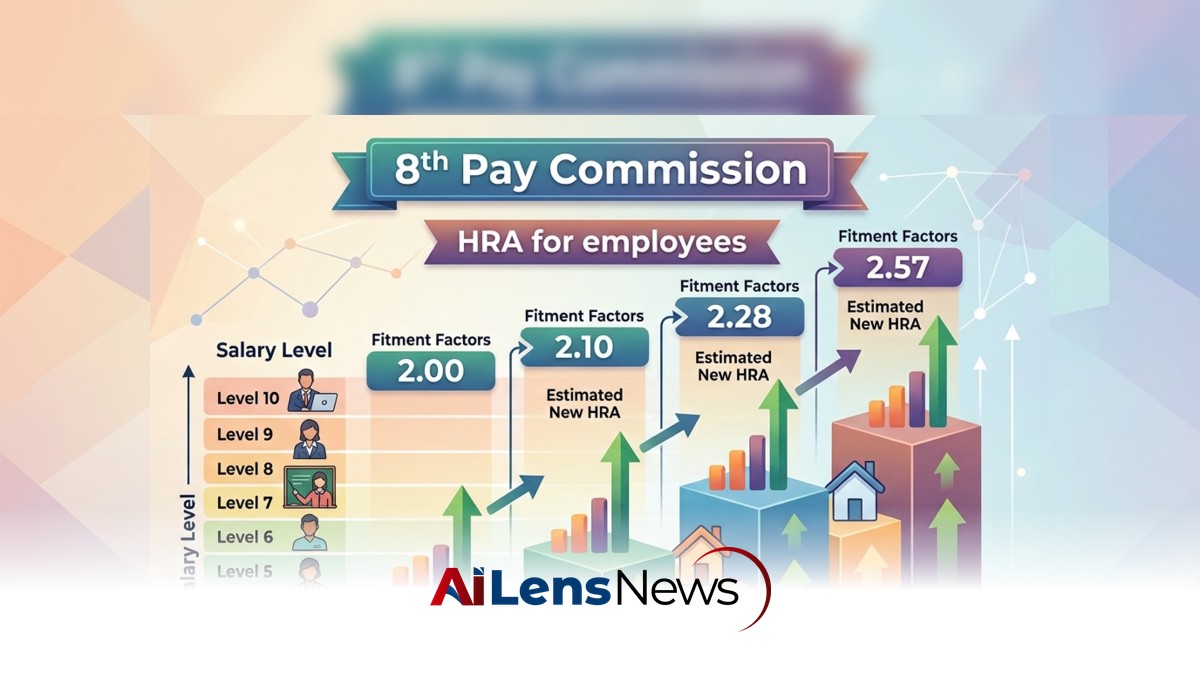


The 8th Pay Commission's meeting in Kolkata concludes today, with employee bodies advocating for increased house rent allowances for central government staff. The potential impact of revised basic salaries on HRA is significant.
New Delhi, India Jul 10, 2026 ALN: The 8th Pay Commission’s meeting with stakeholders in Kolkata is set to conclude today, on Friday, July 10, 2026. This meeting has been pivotal as employee bodies have raised significant concerns regarding the current house rent allowance (HRA) percentages, which are set at 30% for X category cities, 20% for Y category cities, and 10% for Z category cities. HRA constitutes a substantial portion of the salary for central government employees, and any adjustments made by the commission can have far-reaching implications for employees’ financial stability, especially in urban areas where living costs are escalating.
HRA in 7th Pay Commission
During the 7th Pay Commission, the HRA percentages were initially set at 27% for X cities, 18% for Y cities, and 9% for Z cities. However, these rates were subsequently increased to 30%, 20%, and 10%, respectively, following a rise in the dearness allowance (DA) that reached 50% in January 2024. This adjustment was crucial as it acknowledged the growing financial pressures faced by employees, particularly in metropolitan areas where housing costs have soared. The increase in HRA during the 7th Pay Commission was seen as a necessary response to the rising inflation and the cost of living, which has increasingly burdened employees, especially those in urban settings.
8th Pay Commission: Employee Bodies Demand Higher HRA
In light of the rising living costs, numerous central government employee unions have come together to advocate for an increase in HRA rates. They argue that the existing rates are inadequate, particularly for Group C and D employees, who often struggle to find affordable housing in major cities. The demands presented by various employee bodies reflect a consensus on the need for higher allowances, as the current rates do not sufficiently address the financial strain faced by employees living in high-rent areas. The rising cost of housing, coupled with stagnant wages in many sectors, has led to increased calls for a reevaluation of HRA.
From the data presented, it is evident that a significant number of organizations, including the National Council - Joint Consultative Machinery (staff side), are advocating for a 40% HRA on the higher end of the spectrum. Furthermore, there is a strong push for HRA to be merged with DA, particularly when the dearness allowance reaches 25%. The rationale behind this merger is that it would ensure that HRA keeps pace with inflation, as DA is revised biannually. This linkage is seen as a vital step in ensuring that employees are not left behind in terms of their purchasing power, especially in an environment where inflation can erode the value of their earnings.
Why Fitment Factor is a Key Player in 8th Pay Commission HRA Revision
The fitment factor plays a crucial role in determining the revised basic pay of employees, which in turn affects the HRA they receive. As HRA is calculated as a percentage of the basic pay, any increase in the basic salary due to a higher fitment factor will lead to a proportional increase in HRA. For instance, a Level 1 employee with a basic pay of ₹18,000 currently receives ₹5,400 (30% of their basic pay) as HRA if they reside in an X category city like Delhi. If the fitment factor is set at 2.0, their revised HRA would be ₹10,800. Conversely, if the fitment factor rises to 2.28, the revised HRA would increase to ₹12,312, illustrating the significant impact that the fitment factor has on HRA calculations. The implications of the fitment factor extend beyond mere salary adjustments; they can affect employee morale, retention, and overall job satisfaction, as financial stability is closely tied to compensation structures.
How HRA of Level 1-10 Employees Can Change at 2.0, 2.1, 2.28, and 2.57 Fitment Factors in 8th Pay Commission
According to the 7th Pay Commission, central government employees are categorized into Levels 1-10, which includes positions ranging from Group D employees to entry-level civil servants in Group A. The starting basic pay for these levels varies considerably, typically ranging from ₹18,000 to ₹56,100. The calculations presented by Bankbazaar estimate the revised HRA for central government employees at different fitment factors, specifically 2.0, 2.1, 2.28, and 2.57. These calculations are critical as they provide insights into how changes in the fitment factor can directly impact the financial situation of employees across various levels.
For the X, Y, and Z categories, the HRA percentages remain at 30%, 20%, and 10%, respectively. Below is a breakdown of the estimated HRA for Level 1-10 employees based on these fitment factors:
8th Pay Commission HRA Estimates for Level 1-10 Employees
| Fitment Factor | Revised Basic | HRA (X - 30%) | HRA (Y - 20%) | HRA (Z - 10%) |
|---|---|---|---|---|
| 2 | ₹ 36,000 | ₹ 10,800 | ₹ 7,200 | ₹ 3,600 |
| 2.1 | ₹ 37,800 | ₹ 11,340 | ₹ 7,560 | ₹ 3,780 |
| 2.28 | ₹ 41,040 | ₹ 12,310 | ₹ 8,210 | ₹ 4,100 |
| 2.57 | ₹ 43,560 | ₹ 13,068 | ₹ 8,704 | ₹ 4,352 |
The calculations indicate that under the 8th Pay Commission, Level 10 employees could potentially receive an HRA of around ₹43,000 if the fitment factor is set at 2.57. This represents a significant increase from the current allowances, highlighting the financial pressures faced by employees as the cost of living continues to rise in urban areas. The potential increase in HRA is not just a matter of financial relief; it also serves as an acknowledgment of the hard work and dedication of government employees, many of whom are at the forefront of public service.
The implications of these changes are profound. A higher HRA not only aids in alleviating the financial burden of housing costs but also reflects broader trends, including inflation and urbanization. As cities continue to grow and attract more residents, the demand for housing increases, leading to higher rental prices. Consequently, the adjustments to HRA must take into account these realities to ensure that employees can maintain a reasonable standard of living. Moreover, a well-structured HRA can contribute to the overall stability of urban areas, as it can increase disposable income and stimulate local economies.
In conclusion, the ongoing discussions surrounding the 8th Pay Commission are crucial for central government employees, particularly regarding HRA adjustments. The outcome of these negotiations will have a direct impact on the financial well-being of many employees across the country. As the meeting concludes, stakeholders will be closely watching the recommendations made by the commission, which will ultimately shape the financial landscape for government employees in the coming years. The decisions made during this period will not only affect current employees but also set a precedent for future pay commissions, making it essential for the voices of employees to be heard and considered in the final recommendations.
To learn more about the latest developments in Corporate & Industry Insights, stay updated with our exclusive reports and analyses on AiLensNews.

