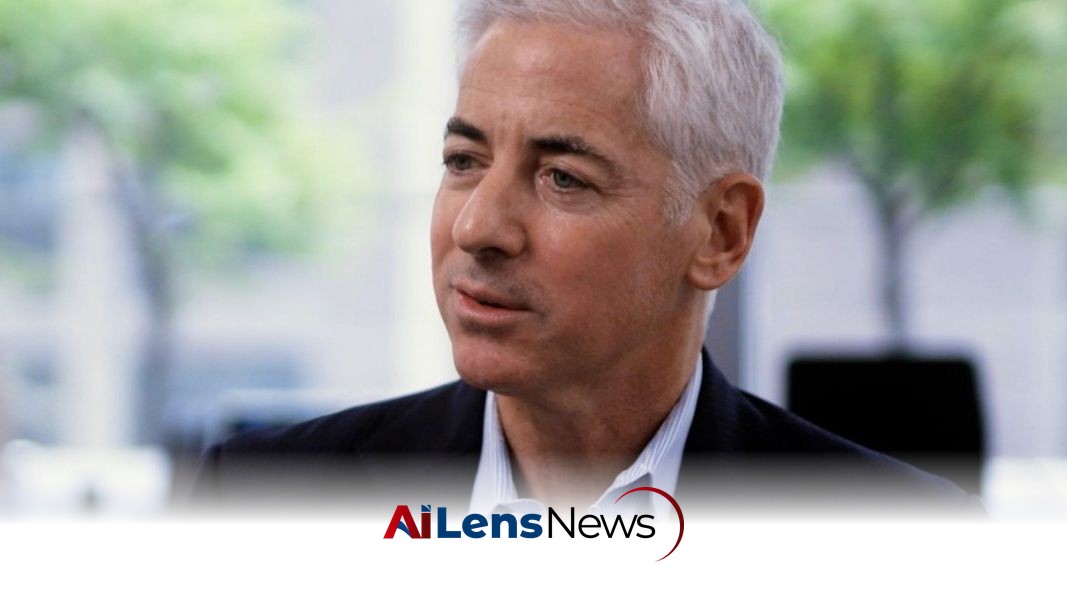



Billionaire investor Bill Ackman shares how a book that inspired Warren Buffett and a $14,000 side hustle shaped his investment career.
Washington DC, United States Aug 11, 2026 ALN: Billionaire Bill Ackman has built a $35 billion hedge fund, led high-profile overhauls at companies like Chipotle, and boasts an eye-watering investment portfolio through his firm, ranging from Amazon to Microsoft. Now, he’s revealing the two things that moved the needle in his career: A book that inspired Warren Buffett and a $14,000 side hustle.
“One early formative experience was at Harvard, where I took a job at Harvard Student Agencies selling advertising for the Let’s Go travel guides—a series of books where Harvard students wrote reviews of hotels around the world,” Ackman recently told Editor-in-Chief Alyson Shontell during ’s Titans and Disruptors of Industry podcast. This job at Harvard Student Agencies, which is a student-run organization that provides various services, was not only a source of income but also a significant learning experience for Ackman, allowing him to hone his sales skills in a competitive environment.
“It was a commission-based business, and I turned out to be a good salesman,” he continued. In fact, he was so good at the job that the student agency was afraid he would out-earn his superiors. “I made $14,000, which felt like a huge amount of money.” This early success instilled in him a sense of confidence and ambition that would shape his career trajectory. As a teenager, Ackman told his dad that he’d be a millionaire by 30, have $100 million by 40, and be a billionaire by 50. And that commission check was his first taste of business success, reinforcing his aspirations for wealth and success in the investment world.
After graduating, he returned home to work for his father, who cofounded and ran New York-based commercial real estate firm Ackman-Ziff Real Estate Group. Although he wasn’t particularly enthusiastic about this role, it served as a pivotal point that directed him toward the career he ultimately wanted to build. “I found the entrepreneurs and developers on the other side of the phone more interesting, and I decided I wanted to be an investor,” he said. His father—an entrepreneurial success in his own right—further influenced his journey into investing. “My dad introduced me to a man named Leonard Marks, who recommended ‘The Intelligent Investor’ by Ben Graham.” This book, authored by Benjamin Graham, is widely regarded as a seminal work in value investing and has profoundly influenced many successful investors, including Warren Buffett, who has often cited Graham as a mentor and a guiding force in his own investment philosophy.
Ackman completed his MBA at Harvard Business School in 1992, and that same year co-founded his first investment firm Gotham Partners with fellow Harvard graduate David Berkowitz. Gotham Partners focused on value investing, a strategy that emphasizes buying undervalued stocks with the expectation that they will appreciate over time. “I went to business school to learn how to be an investor and just followed that path—fortunate to find something I was excited about,” Ackman added, highlighting his commitment to the investment field.
In 2004, after winding down his Gotham Partners venture, Ackman founded New York-based investment firm Pershing Square Capital Management. This firm has since become a powerhouse in the hedge fund industry, with a focus on activist investing, where the firm takes significant stakes in companies and advocates for changes to increase shareholder value. Over more than two decades under Ackman’s leadership as CEO, the company has grown to become a $35 billion titan of industry.
Pershing Square's long-term returns have significantly outperformed the market—those who stayed in since inception have seen their investments compound nearly 16.5% annually for two decades, compared to a 10% return on the S&P 500 over the same period. However, in 2026, the company has recently been underperforming, with Pershing Square Holdings down 11% year-to-date this February compared to the S&P 500’s roughly 1% gain. Despite this recent downturn, in April of this year, Pershing Square raised $5 billion in the largest closed-end fund listing in U.S. history through its combined IPO, demonstrating continued investor confidence in Ackman’s strategies and leadership.
The 60-year-old hedge fund mogul has also grown his own net worth to $11.5 billion, and his influence has grown commensurately within the investment community. A well-timed 2020 bet on corporate credit markets during the COVID-19 crash reportedly turned $27 million into $2.6 billion in a matter of weeks, showcasing Ackman’s ability to navigate volatile markets and capitalize on opportunities. His 2016 bet on Chipotle also paid off handsomely, with Pershing Square nearly doubling its original $1.2 billion investment within a few years before selling off its stake. Additionally, around a decade ago, his activist campaign at Canadian Pacific Railway became one of the most celebrated turnarounds in modern investing, illustrating his effectiveness in advocating for corporate change.
Ackman is still a self-proclaimed “Warren Buffett devotee” who has looked up to the legendary investor as an “unofficial mentor.” This admiration for Buffett's investment philosophy and business acumen is evident in Ackman's strategic decisions and investment approaches. In March of this year, he sought to replicate Buffett’s success with Berkshire Hathaway by taking Pershing Square Capital Management public and gaining access to “permanent capital.” This strategy aligns with Buffett's model of utilizing a structure that allows for long-term investments without the pressure of immediate redemptions from investors.
To entice investors, every 100 shares of the closed-end fund they buy will automatically earn them 20 free shares of Pershing Square. This innovative approach aims to attract a broader base of investors while ensuring that the capital remains within the fund for longer periods, allowing Ackman to pursue his investment strategies without the constraints that often come with traditional hedge fund structures.
Ackman explained that about 98% of Pershing Square’s capital is invested in public companies, where it is often one of the largest shareholders. These investment vehicles are designed primarily to invest in public companies, where Pershing Square frequently holds significant stakes as an active shareholder. The structure of closed-end funds allows investors to sell their shares to other investors rather than redeeming directly from the funds, which enables the vehicles to retain their capital and investments over time. This is similar to Berkshire Hathaway’s permanent-capital structure, which has been instrumental to Buffett's long-term investment success.
“That gives us what Mr. Buffett would call permanent capital,” Ackman explained during the podcast. “Berkshire is a corporation—when people want their money out, they sell Berkshire shares, but the capital stays in the enterprise, and Buffett has done a remarkable job investing it over time.” This emphasis on permanent capital reflects Ackman’s understanding of the importance of stability and long-term vision in successful investing.
In conclusion, Bill Ackman’s journey from a $14,000 side hustle to managing a $35 billion hedge fund is a testament to his entrepreneurial spirit, investment acumen, and ability to learn from the successes of others, particularly Warren Buffett. His career trajectory not only highlights the potential for individual success in the investment world but also underscores the impact of mentorship, education, and strategic thinking in navigating the complexities of finance and investment management.
To learn more about the latest developments in Investments & Portfolios, stay updated with our exclusive reports and analyses on AILensNews.

